
How to Build a Travel Fishing Kit for Retail
A fishing kit can contain plenty of pieces and still leave the customer without a workable setup.
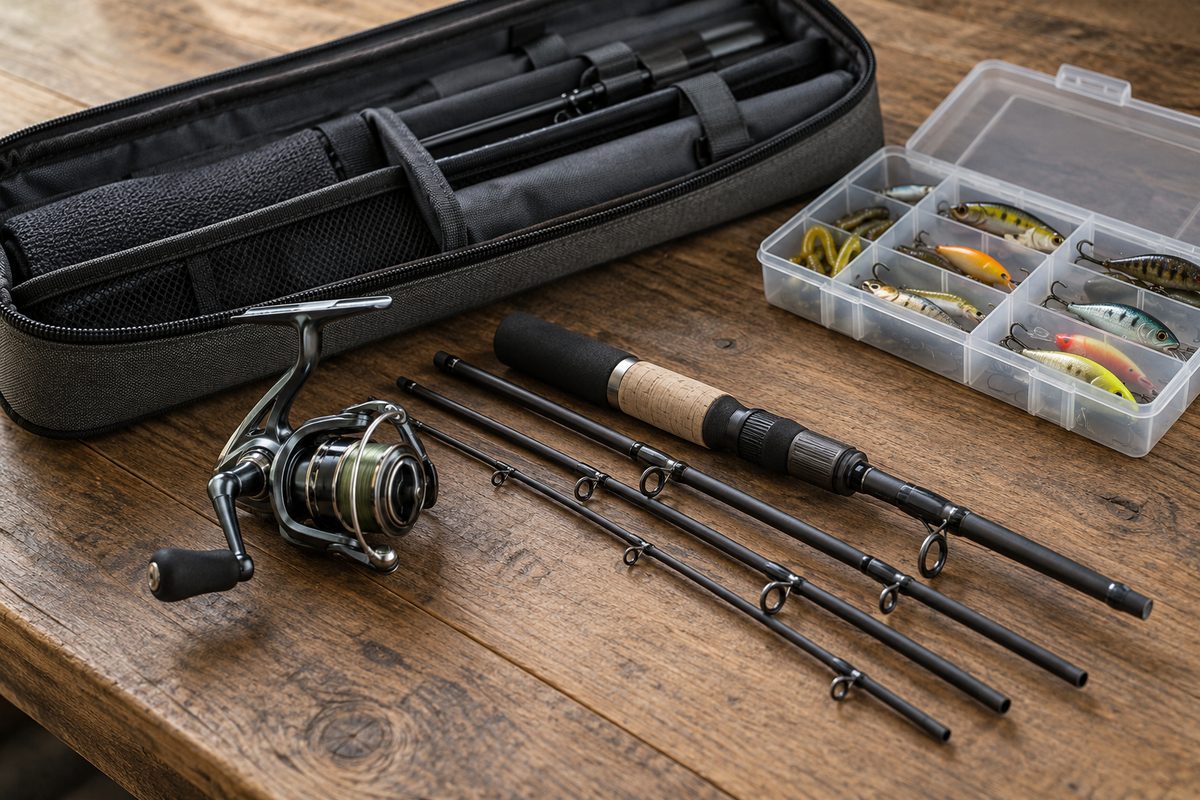
Evaluate a travel kit as a complete setup, including its case. AI-generated editorial illustration.
A fishing kit can contain plenty of pieces and still leave the customer without a workable setup. The reel may fit awkwardly on the rod, the supplied lure may fall outside the rod’s intended range, or the case may close only if the guides are pressed against other components.
For a wholesale buyer, the kit should be evaluated as one product. Define the trip and fishing application first, then choose components that work together. A clear contents list and sensible instructions are more useful than an inflated accessory count.
Choose one use that the kit can serve well
A compact freshwater lure kit and a heavier coastal travel kit need different component decisions. Name the intended environment, target application and experience level. Avoid claiming that one small kit is suitable for every species and location simply because it contains several lure shapes.
Specify the assembled rod length and actual packed dimensions. As an example of clear product fields, Rapala’s listing for the 13 Fishing Fate Quest travel spinning rod states length, power, action, number of pieces and lure-weight range. [1] Those details help define the rod, but a kit buyer still needs to check the longest section and the complete filled case.
Match the components as an assembled setup
Fit the proposed reel to the rod and check the closed reel seat. Confirm that the intended line and lure weights suit the complete application. St. Croix’s engineering guidance connects rod power with the lure and line ranges a rod is intended to handle. [2] Use the actual rod supplier’s specifications for your chosen kit rather than transferring a rating from another brand.
Check the total weight of a rig, including any jighead or added component, when comparing it with the rod’s range. Do not count only the soft bait body. For a reel supplied with line, record the line specification, amount and fill method, then observe line lay and handling on the assembled sample.
Provide a practical setup for the included lures. If a soft bait requires a hook or jighead, either include a compatible option or make the omission clear. A collection of attractive components is not automatically a ready-to-fish kit.
Make the piece count honest and useful
Write an itemized bill of contents with quantity and specification for every part. State how you count pieces. A small bag containing twenty tiny accessories should not obscure the fact that the kit has only one main lure or lacks a required connection.
Choose accessories for a specific job and check their compatibility. Keep hooks contained and separate from unprotected rod sections or the reel. If the kit includes a compartment box, confirm that dividers hold the small parts intended for them. Evaluate the contents after ordinary handling, not only immediately after careful assembly at the factory.
| Buying point | What to specify | What to verify |
|---|---|---|
| Application | Define one core use | Match the component ranges |
| Contents | List every item and quantity | Explain the piece-count method |
| Case | Measure the filled exterior | Protect guides and contain hooks |
| Instructions | Use the ordered configuration | Check assembly with a new user |
Treat the case as part of the product
Pack the complete approved kit and open it as a customer would. Check whether sections can be removed without snagging guides and whether the reel has a stable place. Close the case without forcing it. Ask the supplier to show the intended packing arrangement so the commercial batch follows the same method.
Measure external dimensions when the case is filled and include them in the product description. Avoid an unconditional airline carry-on claim; acceptance depends on the carrier, route, security rules and packed contents. A factual dimension is more useful than an assurance that cannot apply to every trip.
Agree packaging checks for the actual distribution route. A soft carry case that organizes equipment during use may still need protective outer packaging for shipment. Evaluate those two functions separately while keeping the full delivered cost visible.
Review substitutions at kit level
Suppose a reel is unavailable and the supplier proposes another model with a similar size label. Recheck reel-seat fit, balance, line capacity and the case arrangement before approval. The replacement may be acceptable, but its inclusion changes the kit reference and possibly the instructions. Apply the same discipline to the tackle box and lures. A small component substitution can matter when every item has a defined place and purpose inside a compact product.
Give the customer a clear first assembly
Include an accurate contents diagram and concise assembly instructions for the ordered configuration. Explain how the rod sections fit according to the manufacturer’s guidance, how the reel attaches and which included rig suits the intended use. Test the instructions with someone unfamiliar with the kit and correct any step that requires guessing.
A QR link can lead to a demonstration, but essential setup information should remain available when the customer has no connection. Keep the demonstration consistent with the actual kit. If a component changes, update the video and printed instructions before shipping the revised version.
Plan replacement support for the parts most likely to need attention. Identify the kit revision and confirm whether a matching section, reel part or case can be supplied. Do not promise availability without an arrangement. Ask for quotations against the complete bill of contents, filled-case dimensions and approved assembly, then compare each offer as a finished retail product.
Research sources
Sources checked on 7 October 2026. Manufacturer examples are attributed and are not independent tests. Sample procedures and buying decisions are editorial recommendations. Worked examples and scenarios are hypothetical, not market data.
[1] Rapala and 13 Fishing — Fate Quest Travel Rod Spinning. Example of travel-rod specification fields.
[2] St. Croix — Engineering. Relationship between rod power and intended lure and line ranges.