
How to Plan Reorders for a Fishing Tackle Range
A lure family may look healthy in a monthly sales report while its most useful color is unavailable.
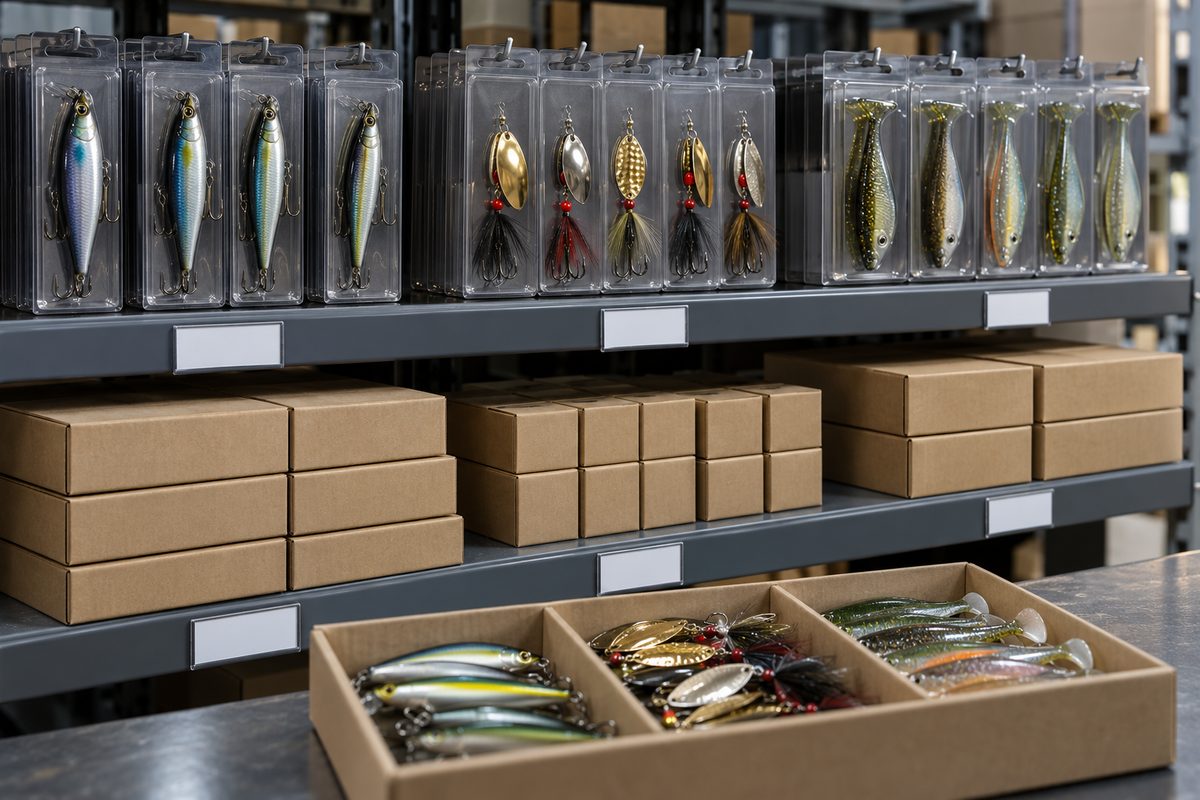
Review availability at the variant level rather than by product family. AI-generated editorial illustration.
A lure family may look healthy in a monthly sales report while its most useful color is unavailable. The slow variants keep the total stock figure high, and the buyer delays a reorder. Dealers see the problem sooner: the item they want cannot be supplied.
Plan replenishment at the level customers actually order. For most tackle ranges, that means the size, color and pack combination rather than the broad product family. Then connect demand to the time it takes for new stock to become saleable in your own warehouse.
Start with usable stock and reliable sales history
Separate stock on hand from stock that can be promised to a customer. Quarantined goods, damaged packs and quantities already allocated to orders need different treatment. Shopify’s inventory guidance distinguishes inventory states for this reason. [1] Whatever system you use, define each field before using it in a reorder calculation.
Review sales by variant and note periods when that variant was unavailable. Zero sales during a stockout do not demonstrate zero demand. Also flag promotions, unusually large dealer orders and returns. Keep the raw record, but decide whether each event belongs in the demand forecast for the next replenishment period.
Measure the whole replenishment interval
Use the time from order release to usable receipt, including any approval, production, inspection, transport and receiving stages relevant to the purchase. A factory’s manufacturing lead time may cover only one part of that interval.
Compare promised and actual dates over completed orders. If the delay comes from late artwork approval or a missed consolidation shipment, increasing the factory production estimate alone will not explain the problem. Record the cause so the next purchase can be planned against the real process.
Shopify’s reorder-point explanation links the trigger to demand during lead time plus safety stock. [2] It is a useful starting model, not a substitute for checking whether your sales and lead-time assumptions fit a seasonal tackle business.
Use a simple calculation with visible assumptions
For illustration, assume a variant is expected to sell 8 retail packs per day, usable replenishment takes 45 days, and the buyer chooses a 120-pack buffer. Expected lead-time demand is 8 × 45 = 360 packs. Adding the buffer gives a reorder point of 480 packs. These are hypothetical planning inputs, not a recommended stock level.
Apply that trigger to a consistently defined inventory position. One practical definition is usable stock on hand plus confirmed incoming stock, less outstanding demand not already deducted. Avoid subtracting the same allocation twice if your system’s available quantity already excludes it.
The reorder point tells you when to review or place an order under that policy. It does not automatically determine how much to buy. Order quantity also depends on the coverage period, minimums, cash available and the risk of being left with stock after demand changes.
| Buying point | What to specify | What to verify |
|---|---|---|
| Demand | Forecast by saleable variant | Flag stockouts and promotions |
| Lead time | Measure order to usable receipt | Separate causes of delay |
| Trigger | Lead-time demand plus buffer | Define inventory position consistently |
| Order quantity | Apply coverage and minimums | Check cash and seasonal exposure |
Adjust for seasonality and supplier constraints
An average across the whole year can understate demand before a local fishing season and overstate it afterward. Use the relevant selling period and dealer information to form a forecast. If there is little history, describe the first plan as an assumption and review it as actual orders arrive.
Run a delay scenario. In the earlier example, an additional 15 days at 8 packs per day would consume the entire 120-pack buffer. That result does not tell you the correct service level; it makes the consequence of the chosen buffer visible. Compare plausible demand and lead-time changes before committing scarce cash.
Ask whether a reorder can use the approved packaging and components or requires fresh setup. Per-color minimums may force you to choose between a larger order and a higher unit price. Compare the cost of extra stock with the value of availability instead of treating the lowest quoted price as the only objective.
Check whether incoming stock arrives in time
An open purchase order is not always useful cover for next week’s demand. Review the promised receipt date as well as the incoming quantity. If one delivery falls after the expected stockout, flag the gap even when total inventory position appears sufficient. Recalculate when the date changes and decide whether a smaller earlier shipment is worth considering. Do not place a duplicate order simply because the overdue stock has become hard to track.
Give slow variants a separate decision
Do not replenish every color in equal quantities merely because the first order was balanced. Review slow items for a clear role, such as a dealer commitment or a deliberate trial. Decide whether to retain, reduce or discontinue them and record the reason.
Keep a short review schedule appropriate to the speed of the business. Focus on exceptions: fast sellers approaching their trigger, late incoming orders, and slow stock that blocks cash. A compact variant report can be more useful than a long catalog-wide forecast that nobody revisits.
Before the next purchase, ask the supplier for the actual replenishment constraints by variant and a realistic sequence to dispatch. Combine that information with your sales record and receiving time. The resulting order will have a reason for its timing and quantity, making it easier to explain to both the supplier and the dealers waiting for stock.
Research sources
Sources checked on 7 October 2026. Manufacturer examples are attributed and are not independent tests. Sample procedures and buying decisions are editorial recommendations. Worked examples and scenarios are hypothetical, not market data.
[1] Shopify — Understanding inventory states. Distinguishes types of inventory availability.
[2] Shopify — Reorder Point Formula. Basis for lead-time demand plus safety stock; numerical example is original and hypothetical.