
How to Plan Retail Packaging for Fishing Tackle
A package can look excellent in an artwork file and fail on the first dealer visit.
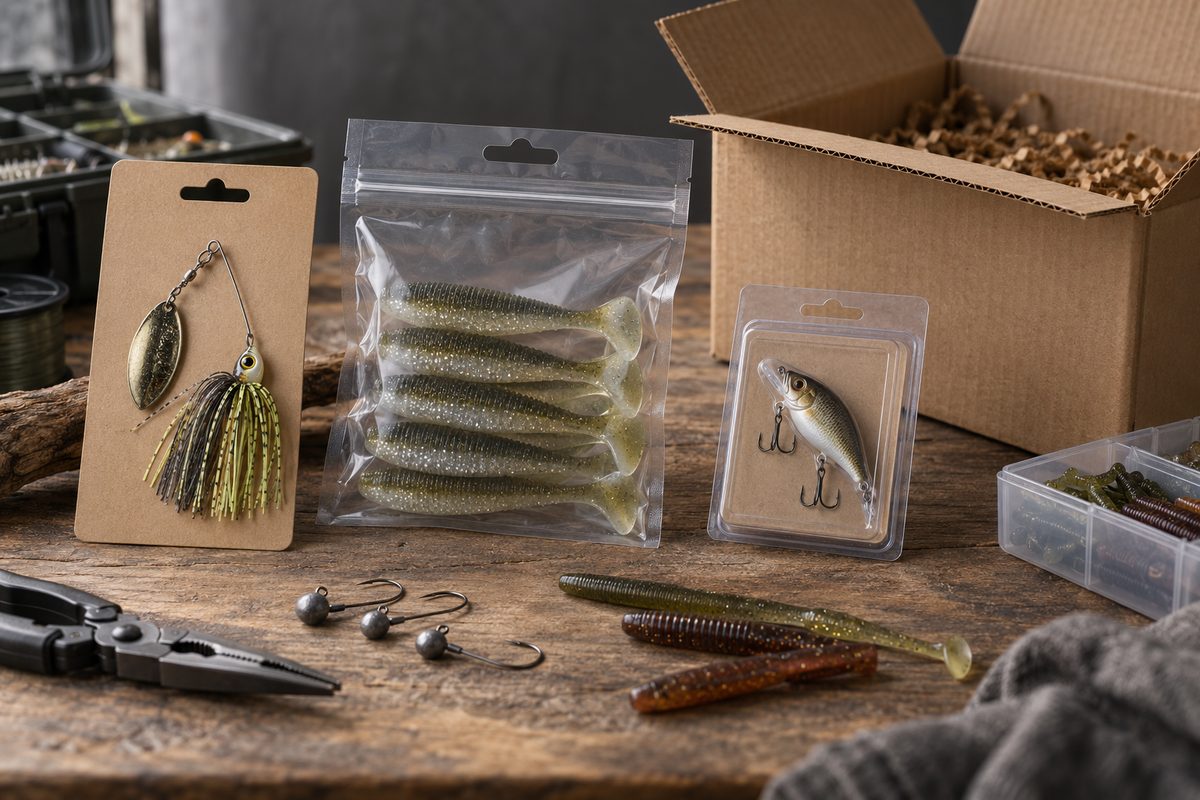
Approve packaging with the actual product inside. AI-generated editorial illustration.
A package can look excellent in an artwork file and fail on the first dealer visit. The hang tab may twist, the product may hide its size label, or the barcode may sit across a fold. For tackle buyers, packaging deserves a physical sample just as much as the item inside it.
Start with the way the product will be displayed, handled and shipped. Then decide what the pack must protect and what the buyer needs to read. The best format for a soft bait pouch may be unsuitable for a hard lure with exposed hooks.
Design around the packed product
Give the packaging supplier the finished item, including its hooks, accessories and any oil or scent. Ask for a sample using the proposed materials and production method. A plain mock-up is useful for dimensions, but it cannot demonstrate the performance of a different film, seal or printed surface.
For a soft lure, check that the body and tail fit without persistent deformation. For a hard lure, consider movement inside the cavity and whether points can damage the pack. For terminal tackle, check containment and opening behavior. Specify the problem the package must solve rather than selecting a material only because it looks more expensive.
Test the shelf experience at actual size
Hang the filled pack on the intended fixture or a representative sample. Check the hanging angle, the load on the tab and how easily one pack can be removed without disturbing the next. Compare the visible front with the information a dealer uses to identify the variant.
Read the smallest text at normal viewing distance. Keep model, size, color and pack count easy to locate, and confirm that the product itself does not hide a transparent label area. Ask a person unfamiliar with the design to identify two nearby variants. Hesitation can reveal a naming or layout problem before a large print run.
Also consider the online product image. Photograph the actual pack and check whether its basic identity remains readable at a realistic thumbnail size. A pack designed solely for a large mock-up may lose its most useful information when reduced.
Reserve space for reliable identification
Assign a stable internal SKU to each saleable configuration. When using GS1 identification, follow its rules for product variations; its guidance explains that size and color variants need distinct GTINs. [1] Keep the barcode data connected to the approved product table so that an artwork revision does not silently swap two variants.
GS1’s barcode-quality guidance identifies quiet zones, contrast, symbol construction and size among the checks needed for reliable scanning. [2] Leave the appropriate clear area and have the barcode prepared for its actual application. A decorative texture or seam behind the code can undermine an otherwise attractive pack.
| Buying point | What to specify | What to verify |
|---|---|---|
| Product fit | Use the finished item | Check movement and deformation |
| Shelf display | Test the loaded hang tab | Read the variant at normal distance |
| Identification | Verify approved barcode data | Check the printed filled pack |
| Shipping | Measure the closed carton | Compare protection and chargeable volume |
Verify the printed sample rather than the screen
Scan the finished printed pack and compare the decoded value with the approved record. Check more than a flat proof: the filled package may curve, reflect light or place a crease across the symbol. Where a trading partner requires formal verification, arrange it for the relevant printed construction; a successful casual scan is not the same assessment.
Agree an artwork approval process with named versions. Keep one person responsible for consolidating corrections so the factory does not receive competing files from several conversations. Retain the approved language, dimensions and barcode data alongside a dated physical sample.
Write product claims from evidence available for the ordered item. Do not add recycled-content, waterproof or other performance wording because the pack supplier uses it for a different construction. Get the material description and relevant support for the actual proposed pack before publishing such a claim.
Check the pack after it has been opened
For a resealable soft-bait pouch, assess the zipper after repeated ordinary use, not only the original factory seal. Ask whether the closure remains usable with the supplied oil or scent present and whether the customer can return the bait without folding it awkwardly. Keep the trial conditions and result with the packaging approval. A pouch that protects the first shipment but works poorly after opening can still create an avoidable customer complaint.
Compare retail protection with shipping volume
Build a master-carton sample using the approved retail packs. Measure it after closing and record gross weight and units per carton. Packaging decisions can affect freight even when product weight changes very little. DHL explains that dimensional weight may determine chargeable weight when it exceeds actual weight. [3] Use the method and rates for the service you are actually considering.
A smaller package is worthwhile only if it still protects the product and works in the sales channel. Compare the full arrangement, including dividers or padding, before removing material. Ask a suitable packaging provider to propose transit checks for the intended route and handling conditions.
A good packaging brief includes the packed item, display method, information hierarchy, identification data and carton requirement. Approve the filled retail pack and shipping arrangement together. That gives the supplier a complete target and gives dealers a product they can display, scan and replenish without unnecessary guesswork.
Research sources
Sources checked on 7 October 2026. Manufacturer examples are attributed and are not independent tests. Sample procedures and buying decisions are editorial recommendations. Worked examples and scenarios are hypothetical, not market data.
[1] GS1 — GTINs for sizes and colours. Identification of product variations.
[2] GS1 — What should I check to ensure good quality barcodes. Barcode quality considerations.
[3] DHL — About Weight. Actual and dimensional weight comparison.