
How to Specify Fishing Rods for a Wholesale Range
Two rods can carry the same medium heavy label and feel quite different in the hand.
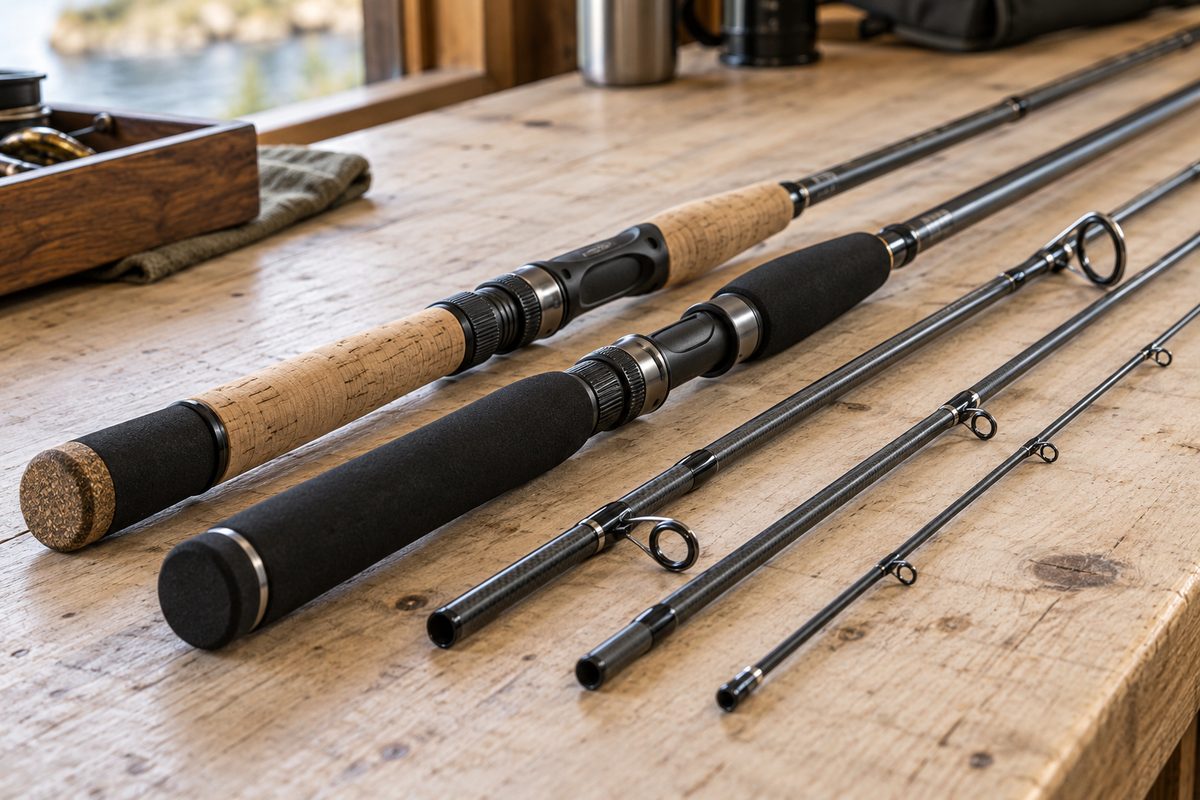
Compare the assembled rod and its transport format as one purchase. AI-generated editorial illustration.
Two rods can carry the same medium heavy label and feel quite different in the hand. One may suit the intended lure well; the other may feel awkward with it. A wholesale buyer needs enough information to explain that difference before putting either rod into a catalog.
Start with the fishing job, the lure range and the way the customer will carry the rod. Those decisions give the supplier a practical brief. Material labels and decorative details become easier to judge once the finished rod has something specific to do.
Separate power from action
Power and action describe different properties. St. Croix defines power by the pressure needed to flex a rod and action by where the blank bends. Its explanation distinguishes faster actions that flex nearer the tip from slower actions that bend farther down the blank. [1] A fast action therefore does not, by itself, describe a heavy rod.
Ask suppliers to state both properties, alongside the intended lure and line ranges. Treat the terminology as a starting description, then compare samples under the same agreed conditions. Do not assume matching letters on two catalogs make the rods interchangeable. A documented sample comparison is more useful than arguing about which supplier has used the label correctly.
Build each model around an application
List the lure weights your customers actually use, including jigheads, trailers and other attached components. Then identify whether the rod will be used mainly from the bank, a boat or while traveling. A long handle that seems comfortable during a showroom check may interfere with a particular retrieve or seating position.
St. Croix’s Legend Tournament Bass specification table lists length, power, action, lure range and technique separately. [2] That structure is useful for a buying brief even when your range is much simpler. Give each proposed model a distinct purpose. If two rods serve the same buyer at nearly the same price, decide what meaningful difference justifies carrying both.
Evaluate the complete rod
Fit the intended reel to the sample. Check that the reel seat closes securely, that the grip does not leave an uncomfortable transition under the fingers, and that the assembly feels suitable for repeated use. Compare the sample with the line and lure class named in the brief, rather than judging only an unloaded rod.
Ask for guide and reel-seat references, grip dimensions, finished weight and the measurement method used for length. A carbon grade on a quotation does not specify guide alignment, handle assembly or the quality of a joint. Keep the component description attached to the finished-rod specification so that substitutions are visible.
| Buying point | What to specify | What to verify |
|---|---|---|
| Power and action | State separately | Compare samples using the same setup |
| Lure range | Include the complete rig | Evaluate the intended working range |
| Components | Name guides and reel seat | Check the delivered assembly |
| Transport | Measure packed length | Approve protection with the rod inside |
Check joints and transport together
For a rod supplied in sections, record the assembled length, longest packed section and type of protective case. Ask the supplier to demonstrate the intended joint fit and assembly procedure. Follow that procedure during the sample evaluation; forcing a joint farther together to eliminate every visible gap can be inappropriate for some designs.
Inspect the assembled alignment and repeat assembly within an agreed trial. Note loosening, rotation or changes in fit, and have the supplier explain what it considers acceptable. Avoid improvising extreme bending or lifting demonstrations. If proof-load or fatigue testing is needed, agree a suitable fixture, method and acceptance criterion with a qualified provider.
The packing sample should contain the actual rod configuration. Check that guides and tips cannot rub against each other during ordinary handling, and that an end impact does not travel straight into an unsupported tip. Measure the packed carton rather than estimating it from the rod’s advertised length.
A practical sample comparison
Imagine two proposed bank-fishing rods that cover the same advertised lure range. One packs shorter, while the other has a handle layout that suits the intended retrieve better. Write both findings down before choosing. The shorter transport length may matter more to a mail-order customer; the grip may matter more to someone using the rod all day. Neither difference is captured by the power label. Let the intended customer decide the priority rather than presenting one sample as universally better.
Plan for the service question before placing the order
Ask what happens if a customer needs a replacement tip section, guide or reel-seat component. Confirm which parts can be supplied and how the exact rod revision will be identified. A replacement section that shares a model name may still need a fit check. Avoid making a public service promise until the supply arrangement is established.
Keep the opening assortment small enough to explain. A retailer should be able to describe the reason for moving from one model to the next without reciting a materials brochure. Request quotations against the same component list, packaging and sample criteria, then compare the full delivered offer.
A useful inquiry includes the target application, assembled and transport lengths, intended reel, lure range and preferred handle layout. Ask the supplier to identify the closest existing model and list every proposed change. That gives the next discussion a physical reference and keeps cosmetic choices from taking over the project.
Research sources
Sources checked on 7 October 2026. Manufacturer examples are attributed and are not independent tests. Sample procedures and buying decisions are editorial recommendations. Worked examples and scenarios are hypothetical, not market data.
[1] St. Croix — Engineering. Definitions of rod power and action.
[2] St. Croix — Legend Tournament Bass. Example of application-specific rod specification fields.