
Choosing Hard Baits by Running Depth and Action
A wall of hard baits can look varied while offering the customer very little practical choice.
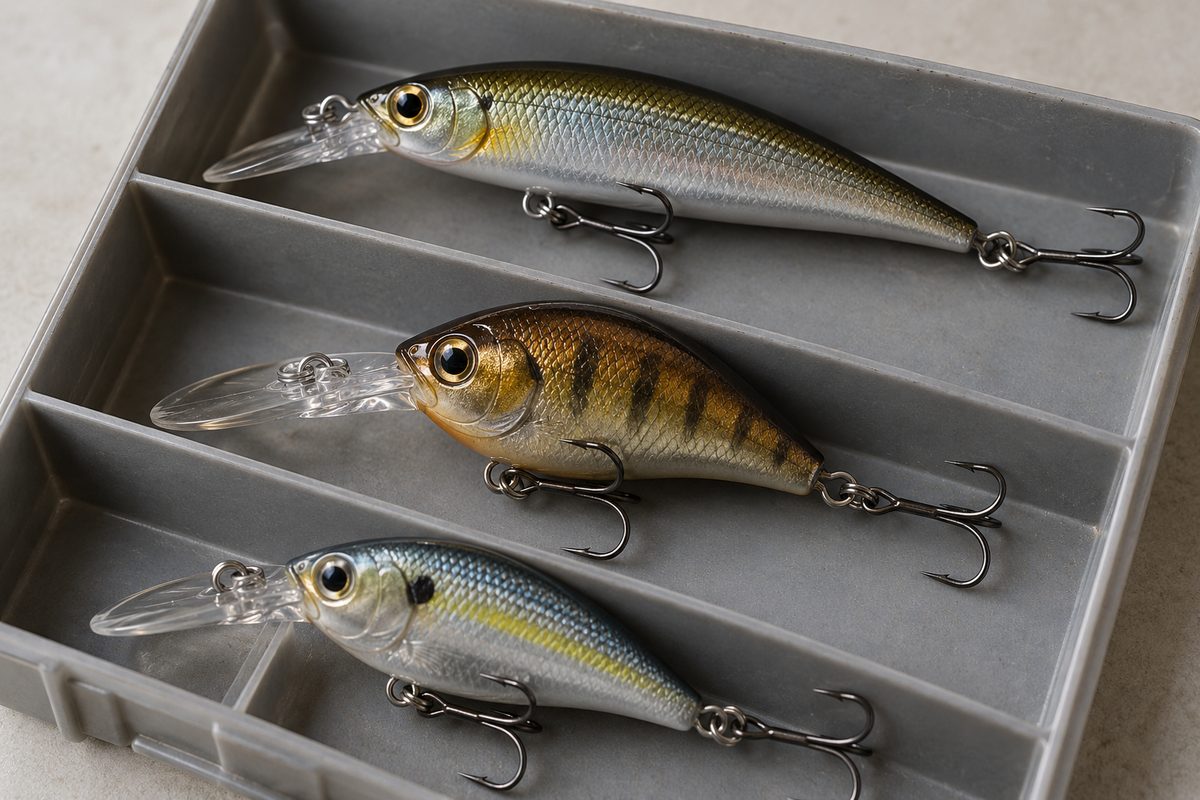
A hard-bait assortment should offer useful differences in presentation. AI-generated editorial illustration.
A wall of hard baits can look varied while offering the customer very little practical choice. Ten finishes on similar bodies may all cover roughly the same job. A smaller assortment with clear differences in running depth and presentation can be much easier for a dealer to explain.
Begin with the water the customer intends to cover. Then compare the lure’s size, buoyancy and action under stated conditions. Color belongs in that decision, but it should not conceal the fact that two proposed models may do almost the same thing.
Use depth as a starting specification
Ask for a running-depth description for each size, not a single figure pasted across an entire family. Rapala’s DT series table lists running depth alongside body length, weight and hook size by model. [1] That format is useful because a buyer can see that the assortment changes in more than appearance.
Keep the difference between a published depth claim and a result obtained with your own sample clear. Ask how the supplier established the claimed range and whether it describes casting or trolling. A product that reaches a depth during one long trolling pass has not automatically demonstrated the same performance during an ordinary cast.
Record the tackle and retrieve conditions
Rapala’s depth-chart page notes that line and retrieve or trolling speed affect swimming depth. [2] For a sample comparison, record the line type and diameter, connection, retrieve method and relevant distance or line-out measurement. Without those details, two videos may show different setups rather than different lure performance.
Precision Trolling Data explains that it monitors line diameter, line type, lead length and speed when documenting dive profiles. [3] You do not need to reproduce a commercial testing program to ask sensible supplier questions. You do need a repeatable setup before treating a number as a purchasing specification.
For a casting lure, ask for a demonstration at the intended retrieve range. Observe tracking and stability as well as depth. If the lure rolls out at a speed your customer is likely to use, that deserves investigation even if the slow demonstration looks convincing.
Approve buoyancy on the finished assembly
Record whether the model is intended to float, suspend or sink and how that behavior is checked. Test it with the approved hooks, split rings and line attachment. Ask what water conditions were used. A change in components can alter the balance, so an unfinished painted body is not enough for final approval.
When a suspending action is central to the product, agree what small rise or fall is acceptable over a stated observation period. Avoid implying perfect suspension in every environment. A clear, limited description is easier to support and gives the customer a realistic expectation.
| Buying point | What to specify | What to verify |
|---|---|---|
| Running depth | State casting or trolling use | Record line and retrieve conditions |
| Buoyancy | Test the complete assembly | Define the observation period |
| Action | Show a continuous sequence | Check recovery and stability |
| Assortment | Give each model a role | Avoid unexplained overlap |
Compare actions that customers can distinguish
Give each proposed body a plain-language description of its intended presentation. Ask the supplier to show a steady retrieve and any pause or twitch behavior relevant to that model. Keep the full sequence long enough to see recovery after the input, rather than relying on a few attractive frames.
Check the assembly while examining the action. Look for hook-to-hook contact, repeated fouling around the lip or line tie, and component interference. Confirm whether the sample has been manually adjusted. If tuning is part of production, ask how that step is controlled and recorded for the commercial order.
A small opening range can be organized by distinct depth or presentation needs, with a restrained color selection within each model. Use retailer requests or existing sales to choose the gaps worth filling. Do not turn general color advice into a claim that a particular finish will outperform everywhere.
Separate a new color from a new configuration
A supplier may present a hook change as a minor update made alongside a new finish. Treat the component change separately. Weigh and observe the finished sample using the established setup, and compare it with the approval reference. If its behavior changes, decide whether it still belongs in the same product position. This review prevents the catalog from promising one action while the latest shipment quietly delivers another, even when the body mold has stayed the same.
Keep the product description tied to the evidence
List the measurement convention for body length, total weight and hook configuration. A body measured without its lip is different from a total-length measurement that includes it. Resolve that difference before comparing quotes or preparing a product table.
Retain the final action clip with the sample revision, test setup and component list. If the supplier changes the internal weight or hooks on a reorder, review the behavior again. A change that improves one characteristic can move the lure away from the application originally approved.
Send inquiries by application: the intended water layer, retrieve style, lure size and tackle class. Ask suppliers to propose the few models that genuinely cover those requirements and explain the overlap. That produces a more useful wholesale range than selecting a large number of finishes before learning where the lures run.
Research sources
Sources checked on 7 October 2026. Manufacturer examples are attributed and are not independent tests. Sample procedures and buying decisions are editorial recommendations. Worked examples and scenarios are hypothetical, not market data.
[1] Rapala — DT Dives To Series. Example of model-specific depth and component fields.
[2] Rapala — Rapala Depth Chart. Notes that tackle and retrieve conditions affect swimming depth.
[3] Precision Trolling Data — About Precision Trolling Data. Describes controlled variables used in its dive-profile testing.