
Buying Fishing Line for a Wholesale Range
A line labeled 20 lb can occupy a very different amount of spool space from another line with the same label.
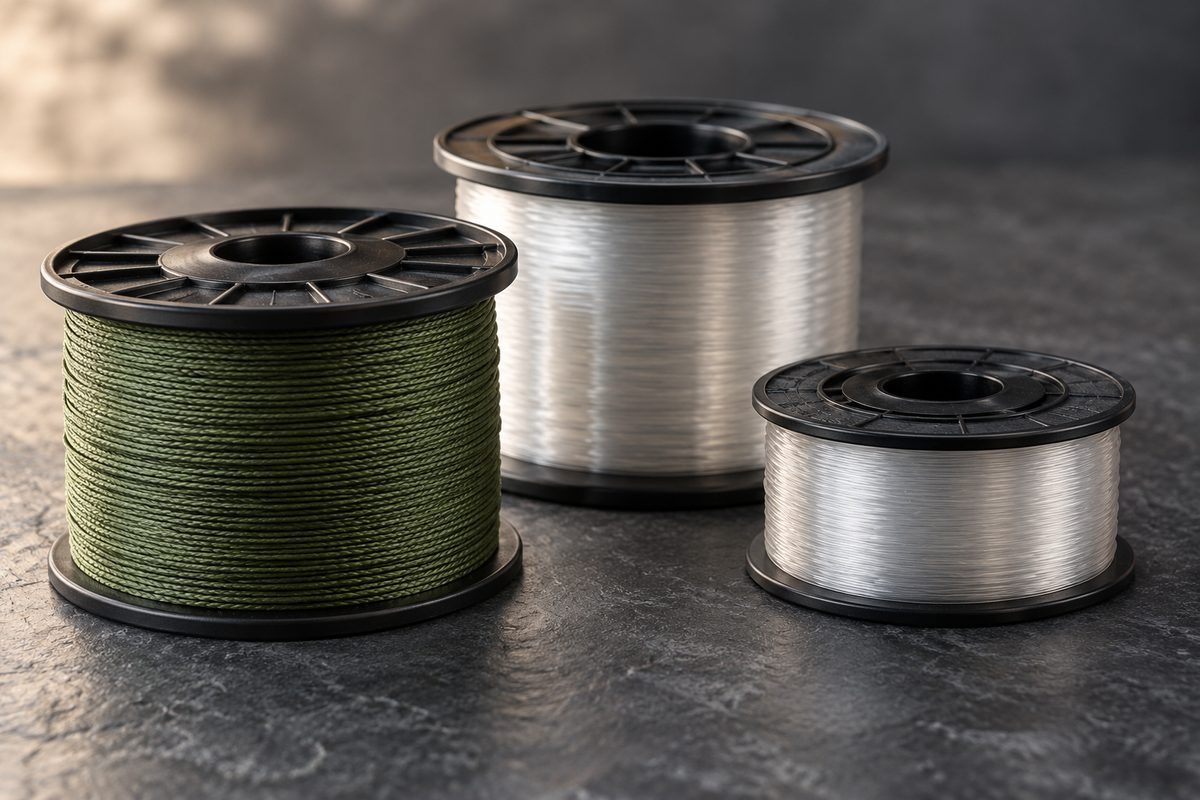
Line appearance alone cannot establish its material or performance. AI-generated editorial illustration.
A line labeled 20 lb can occupy a very different amount of spool space from another line with the same label. Two clear lines may also have different materials despite similar packaging. These details matter when a retailer has to explain casting behavior, capacity or the reason for a price difference.
Build a fishing-line range around documented product differences. Identify the material, intended use, diameter and supplied length first. Then decide which performance claims can be supported by a repeatable test and which belong only to a supplier’s marketing description.
Make the material description unambiguous
Berkley’s freshwater line guide distinguishes nylon monofilament, PVDF fluorocarbon and braided lines made with UHMWPE fibers. [1] Those categories are a useful first division, but each contains products with different handling characteristics. Ask the supplier to describe the particular construction offered rather than relying on a generic family name.
Be especially careful with fluorocarbon wording. Seaguar explicitly distinguishes fluorocarbon-coated nylon from 100 percent fluorocarbon in its FAQ. [2] If the product is coated nylon, the label and quotation should say so. A transparent appearance or a simple water demonstration does not prove composition.
Also establish whether the product is intended as main line or leader. A short leader spool and a reel-filling main line may use different specifications even when they share a nominal breaking-strength label. Ask for a product-specific explanation of the intended use and supporting documentation.
Compare diameter and breaking strength together
Record the stated diameter beside the strength label and ask how each was determined. For braided line, request the measurement method because a flexible, compressible construction can be difficult to describe with one casual measurement. Do not copy a conversion from a different brand’s size chart and present it as a verified diameter.
Separate straight tensile results from knot results. A sample that performs well in one test may behave differently with a particular knot. Ask the testing provider to define conditioning, sample count, gauge length and pull method, then retain the individual results as well as any average. A single strongest result is a poor purchasing reference.
Use the intended knot and reel during evaluation
Choose a practical knot and tying procedure for the sample comparison. Keep the operator, wetting method and trimming procedure consistent, and record where failures occur. If knots fail during tying, investigate the procedure and sample before turning that result into a product-wide conclusion.
For a main line, spool a suitable reel and check handling through ordinary casts and retrieves. Observe loose coils, line digging, obvious coating transfer or other behavior relevant to the product. These observations help identify questions for further testing; they do not justify a universal casting-distance or abrasion-resistance claim.
| Buying point | What to specify | What to verify |
|---|---|---|
| Material | State the actual construction | Keep coated nylon distinct from full fluorocarbon |
| Strength | Identify the test basis | Separate straight pull and knot results |
| Diameter | Record units and method | Avoid borrowed conversion charts |
| Length | Agree verification and tolerance | Check the finished retail spool |
Check what is actually supplied on the spool
Agree how supplied length will be verified and what tolerance applies. Packaging marked with a length should correspond to the actual saleable spool, not an estimate based only on bulk material weight. Check that the end is secured without damaging the line and that the retail spool unwinds in a usable way.
Compare samples from more than one position in the supplied material when the evaluation plan calls for it. Ask how production lots will be identified on the pack. If a complaint appears months later, a lot reference is much more useful than trying to distinguish clear lines from customer photographs.
Review the label at actual size. Keep material, diameter, strength, length and units easy to find. Avoid adding absolute phrases such as invisible, unbreakable or zero memory simply because similar wording appears in another catalog. Describe only what your own product evidence supports.
Read an abrasion claim with its test conditions
If a supplier reports better abrasion resistance, ask what the line rubbed against, under what load and in what condition. Compare diameter as well as the strength label. A result on one rough surface does not establish superiority around every rock, shell or guide. Keep the original report attached to the precise sample identity. If the proposed order uses a different coating or diameter, ask whether that report still applies before repeating the claim on a product page.
Give every spool size a commercial purpose
Decide which lengths suit a reel fill, a leader application or a workshop supply format. An apparently attractive unit price can lose its advantage if the customer needs two spools for one job. Compare cost on both a saleable-spool basis and a consistent length basis while retaining the material and diameter distinctions.
Do not multiply colors and strengths before checking likely demand. Use dealer requests or existing sales to decide where a second option solves a real problem. Ask whether minimums apply by bulk production run, diameter, color or printed spool label; those requirements may create different stock commitments.
A clear request for quotation names the material construction, use, strength and diameter targets, retail length, packaging and proposed test basis. Send that same request to each supplier. It gives you a better chance of comparing equivalent products and gives the retailer a description that remains useful after the sale.
Research sources
Sources checked on 7 October 2026. Manufacturer examples are attributed and are not independent tests. Sample procedures and buying decisions are editorial recommendations. Worked examples and scenarios are hypothetical, not market data.
[1] Berkley — Choose the Right Line for Your Fishing Needs. Material categories; broad product claims are not adopted as universal findings.
[2] Seaguar — Understanding Fluorocarbon and FAQs. Distinguishes coated nylon, full fluorocarbon, main line and leader products.