
How to Compare Spinning Reels for Wholesale Orders
A spinning reel can feel smooth on a showroom counter and still leave important buying questions unanswered.
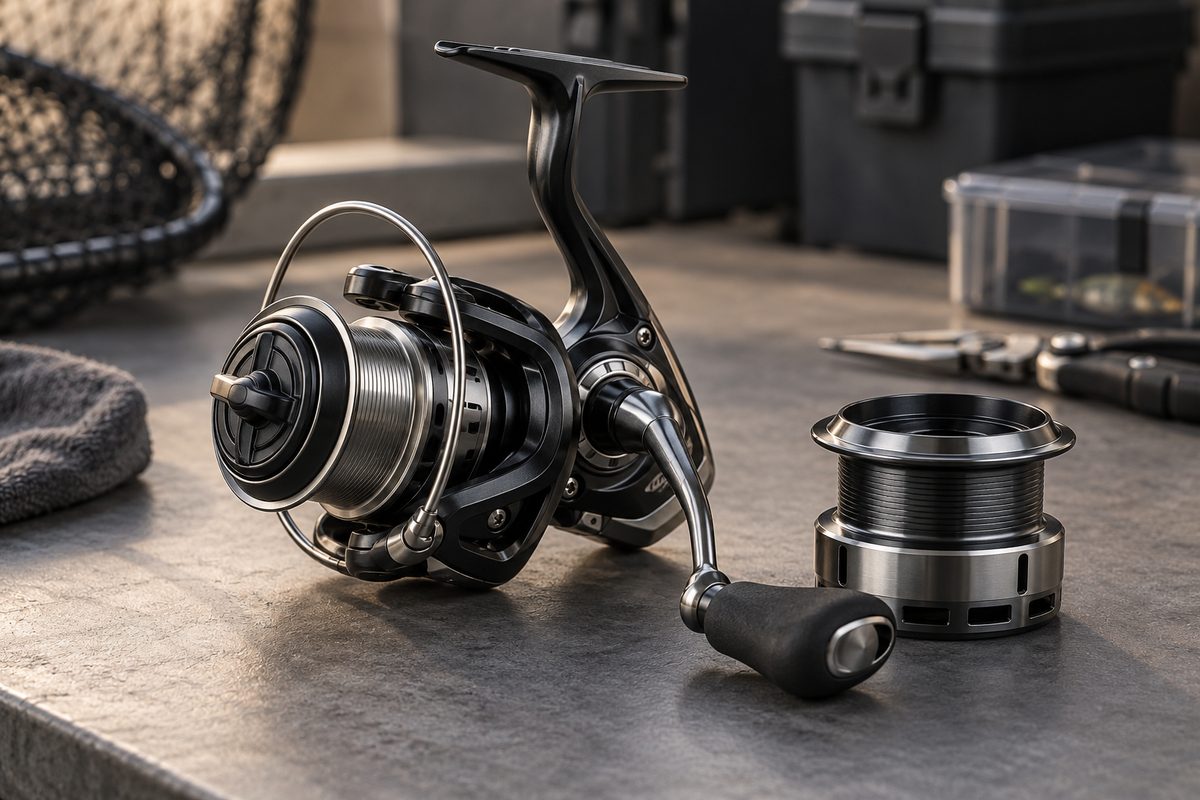
A spinning reel comparison should include the spool and intended line. AI-generated editorial illustration.
A spinning reel can feel smooth on a showroom counter and still leave important buying questions unanswered. How does it lay the chosen line? Does the drag release evenly at the intended setting? Can a retailer obtain the right spare spool? A free-spinning handle does not settle any of those points.
For a wholesale range, compare reels as complete products with a defined use and a support plan. The specification sheet should help you choose samples, while the sample evaluation should explain what your customer will notice after the first few trips.
Compare retrieve as well as gear ratio
Gear ratio describes the relationship between handle turns and rotor rotation on a spinning reel. Line retrieved per turn also depends on the effective diameter of line on the spool. A ratio alone cannot tell a buyer how much line a reel recovers.
Shimano’s FX table illustrates the distinction. Its listed 1000 and 2500 models both have a 5.0 ratio, but the published retrieve figures are 61 and 71 centimeters per crank respectively. [1] These are manufacturer specifications for those models, not independent measurements. Ask suppliers to provide both values and explain the spool-fill condition used for a retrieve measurement.
Keep the units visible in your comparison sheet. A figure in inches per turn is easy to mistake for centimeters when copying specifications between catalogs. Confirm the finished configuration, including handle length and spool, before accepting a revised value.
Make capacity meaningful for your customer
A size number such as 2500 is a model-family label, not a complete capacity specification. Ask for capacity with an identified line type and stated diameter or recognized line designation. For a proposed combo, fill the sample with the actual line you plan to supply and observe the resulting line lay.
Record whether the sample has an obvious build-up near a spool edge, whether the line roller turns as intended and whether the spool lip has damage. These are proposed sample checks, not a substitute for a controlled durability test. Use a consistent fill level so that one reel is not disadvantaged by an overfilled spool.
Test the drag where the reel will be used
Maximum drag is only one specification. Ask the supplier how that figure was obtained and whether it is an operating recommendation or a limit under its test method. Then evaluate release at the lower settings relevant to your intended line and application.
Agree a repeatable check with suitable equipment. Note the starting resistance, the consistency of line release and any change during the agreed sequence. Do not infer long-term heat performance from one short pull. If extended drag operation matters for the intended use, put that requirement into the test brief before comparing quotations.
| Buying point | What to specify | What to verify |
|---|---|---|
| Retrieve | Ratio and line per turn | Use a declared spool-fill condition |
| Capacity | Line type and diameter | Check with the intended line |
| Drag | Method and working settings | Record release behavior |
| Support | Parts drawing and revision | Confirm availability before promising service |
Ask what the bearing count actually includes
A total bearing figure tells you little about placement, protection or the rest of the mechanism. Request a breakdown of ball and roller bearings, along with relevant component references. Compare handle play, bail operation and line-roller behavior on the assembled sample rather than choosing the highest number on a label.
Also clarify any claim about water protection. A vague reference to sealed construction should not become a promise that the reel can be submerged. Shimano’s general maintenance guidance advises basic cleaning and cautions against immersing a reel. [2] Use the manual for the actual model you sell when writing customer care instructions; an example from another brand does not establish your product’s protection rating.
Give a smaller specification a fair comparison
If two reels offer different maximum drag figures, avoid ending the comparison there. Consider a trial in which both are set to the same relevant working resistance, mounted on the same rod class and filled with the same line. Record the setup and observed behavior. You may still prefer the higher-rated model, but the decision will also consider line management and handling. This is a proposed comparison method, not a claim that a lower specification will outperform a higher one.
Include support in the wholesale comparison
Ask for an exploded parts drawing and a revision identifier that matches the ordered model. Confirm which spare spools, handles, bail assemblies or other parts can be purchased, and whether they are interchangeable across the proposed range. Put any repair or replacement arrangement in writing before presenting it to dealers.
Consider an opening range in which each size has a clear application. A smaller number of well-described models is easier to train staff on and support than a broad selection separated mainly by paint color. Keep the approved reel, instruction sheet and packaging together so that a reorder can be compared with the same reference.
Send the supplier a brief naming the intended fishing environment, line and rod class, capacity requirement and relevant retrieve range. Ask for the closest model plus supporting specifications and service information. The useful offer is the one that can be checked and explained, including what happens when something needs attention.
Research sources
Sources checked on 7 October 2026. Manufacturer examples are attributed and are not independent tests. Sample procedures and buying decisions are editorial recommendations. Worked examples and scenarios are hypothetical, not market data.
[1] Shimano — FX spinning reel. Manufacturer model table for ratio, retrieve and capacity.
[2] Shimano — Reel Maintenance. General care guidance including avoiding immersion.