
Why a VIB works, and what that means for the order
A VIB is bought for vibration rather than for appearance.
- A VIB is detected by the lateral line before it is seen, so its first job is to make noise rather than to look like anything.
- Sink rate is set by ballast, not by body length, so two baits of the same length can fish different depths.
- In our own six-listing VIB sample, per-piece rows run US$0.24 to US$1.88 and one of the six is priced per bag rather than per piece.
A vibration bait is the clearest case in this catalogue of a product bought for something a photograph cannot show. That is not a marketing point; it changes which fields a buyer has to fix before a factory can quote.
The lateral line comes first
A fish carries a sense organ that runs along each flank and responds to pressure and vibration in the water. It works in conditions where eyes do not: coloured water, depth, low light. For a bait that displaces water as it travels, that organ is the first thing the fish uses and the last thing a product photograph can evidence.
This is why a vibration bait keeps producing when a visual lure has gone quiet, and it is also why the category behaves differently from everything around it in a catalogue. A minnow is bought for a silhouette. A crankbait is bought for a diving depth. A vibration bait is bought for a signal.
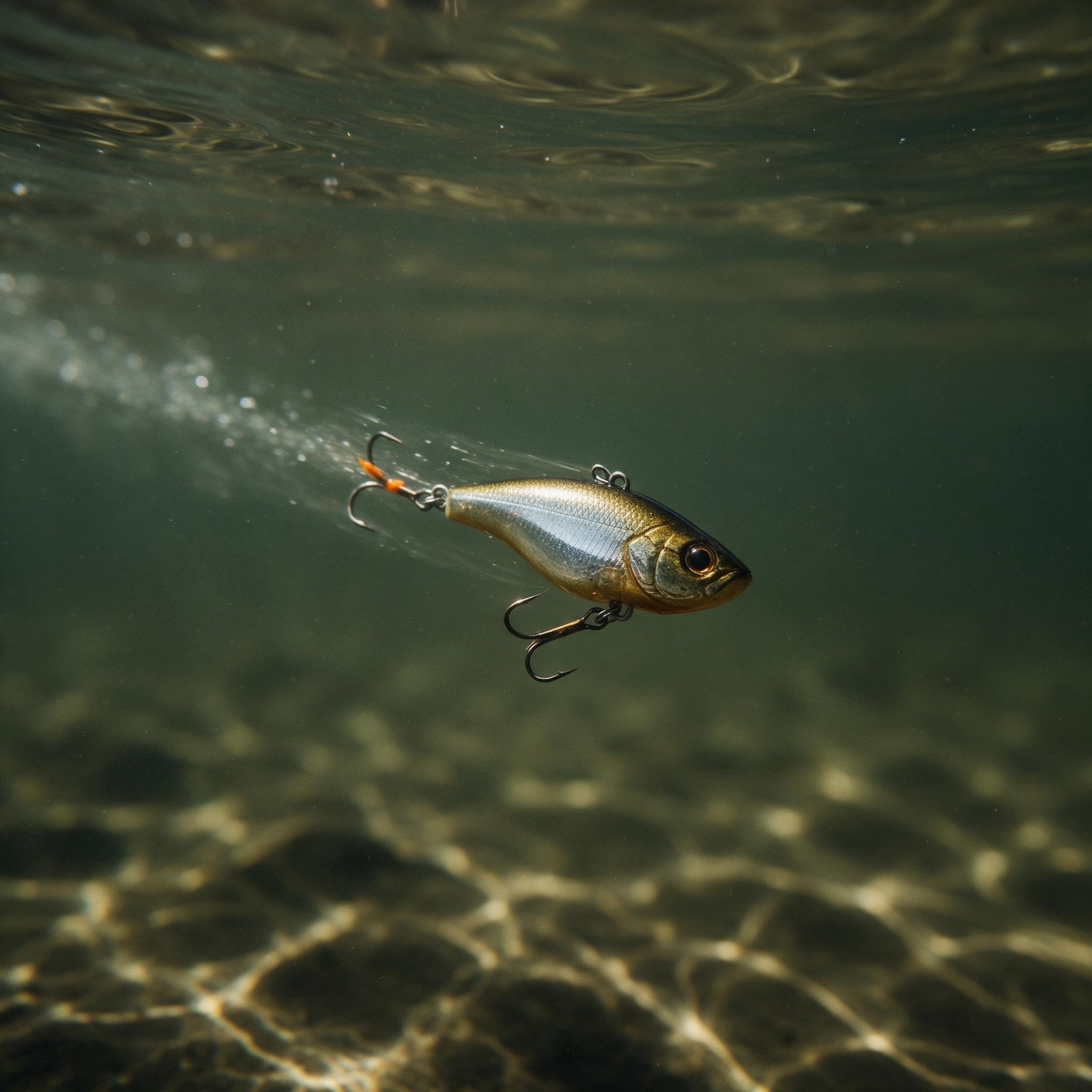
Vibration is a reaction, not an appetite
The second consequence is behavioural. A bait that keeps displacing water in a fish's space draws a strike that is not a feeding response. Anglers call it a reaction bite, and it explains a pattern that otherwise looks irrational: a fish that has refused everything else takes a bait it does not want to eat.
For a buyer, that is the argument for stocking the category at all. It is not competing with the rest of the assortment on realism. It occupies a different trigger, which is why it sells alongside visual lures rather than instead of them.
Three fields that are not in the photograph
If the product is a signal, then the specification is the parts that produce it. In our records, three fields carry most of the weight.
The rattle chamber. Rattle design is a published choice with two schools behind it. One imitates a volume of forage using several smaller chambers, on the reasoning that a school of baitfish reads differently from a single knock. The other uses one heavier clack. These are different products built from the same body, so a specification that names only the colour has not named the sound.
The weight-to-size ratio. Sink rate is set by ballast, not by body length. Two baits of identical length can hold different depth bands if the internal weight differs, which is why length is the most visible dimension of a vibration bait and the least informative. A quotation that gives length alone has not told you how the lure fishes.
The line-tie position. Where the line attaches decides how the bait tracks under a retrieve and is a common source of two batches behaving differently from one another. It is a mould or insert decision, and it belongs in the order rather than in a sample review.
What this does to the quotation
Two of those three fields are assembly, not mould. The rattle chamber is an internal part; the hooks are added; the ballast is set at build rather than at moulding. That has a practical effect on how a quotation should be read: the body can be identical across two orders and the price still differ, because what was added to it differs.
It also explains the pattern in our own sample. Six sampled VIB listings span a published range, but one of the six figures is a per-bag price rather than a per-piece price, so the top of that published band is not comparable with the bottom. Per-piece rows in the same sample run US$0.24 to US$1.88. The unit, not the lure, is where this product type goes wrong first.
What to send before asking for a price
A vibration bait brief needs four fields and no more to become quotable:
- The weight-to-size ratio, or the target sink rate and the depth it is meant for.
- The rattle configuration, stated as a chamber type rather than as "with rattle".
- The line-tie position.
- The hook configuration, which is quoted separately.
Everything a catalogue normally leads with, including colour and finish, sits behind those four. Colour is a finishing changeover; the other three are the product.
Sources 5 cited
- The sampled VIB listings behind every figure on this page, with unit and MOQ on each row
- How rattle design is described by manufacturers, and what the two schools are
- Our rule for separating evidence types rather than merging them
- UN Comtrade — China export statistics under HS 9507, 2023-2024 (retrieved from the official API)
- Harmonized System heading 9507 (rods, hooks, reels, lures) — US HTS lookup
Every figure on this page traces to one of these. The same list is declared in the page structured data (schema.org citation) and in the Markdown twin.