
What a first US order should carry
A first order is an MOQ decision before it is an assortment decision, because the MOQ floor varies by more than an order of magnitude across this catalog and each floor buys a different process.
- MOQ floors across our samples run from 20 pieces on rods to 1,000 on the cheapest soft plastic, a 50x spread.
- Rod records the lowest floors at MOQ 20 to 100, and also the highest price spread at US$9.15 to US$132.55 per piece.
- Hard lure records MOQ 100 on every listing in the sample, the most uniform band in the catalog.
This page is a decision table rather than a recommendation. It sets out the MOQ floor and the recorded band for every type on this site, and it is deliberately silent on what will sell.
The floors, in one place
These are the MOQ figures our own samples record, from lowest floor to highest.
- Rod - MOQ 20 to 100 pieces, the lowest floors in the catalog. Three sampled listings, US$9.15 to US$132.55 per piece, the widest price spread we record.
- Soft lure - MOQ 50 to 1,000 pieces. Six listings, US$0.20 to US$3.85. The widest MOQ spread of any type.
- Spoon and spinnerbait - MOQ 50 to 500 pieces. Six listings, US$0.31 to US$6.00, the widest published band.
- Hard lure - MOQ 100 on every listing. Six listings, US$1.85 to US$3.20. The most uniform band in the catalog.
- Fishhook - MOQ 100 to 2,000 pieces. Nine listings, US$0.07 to US$2.40. The largest sample and the widest MOQ range.
- Metal jig - MOQ 200 on four of five listings, 100 on the fifth. Five listings, US$0.97 to US$2.01.
- Crankbait - MOQ 200 to 500 pieces. Three listings, US$0.30 to US$0.85, and the narrowness of that band is a sampling artefact we state on the record.
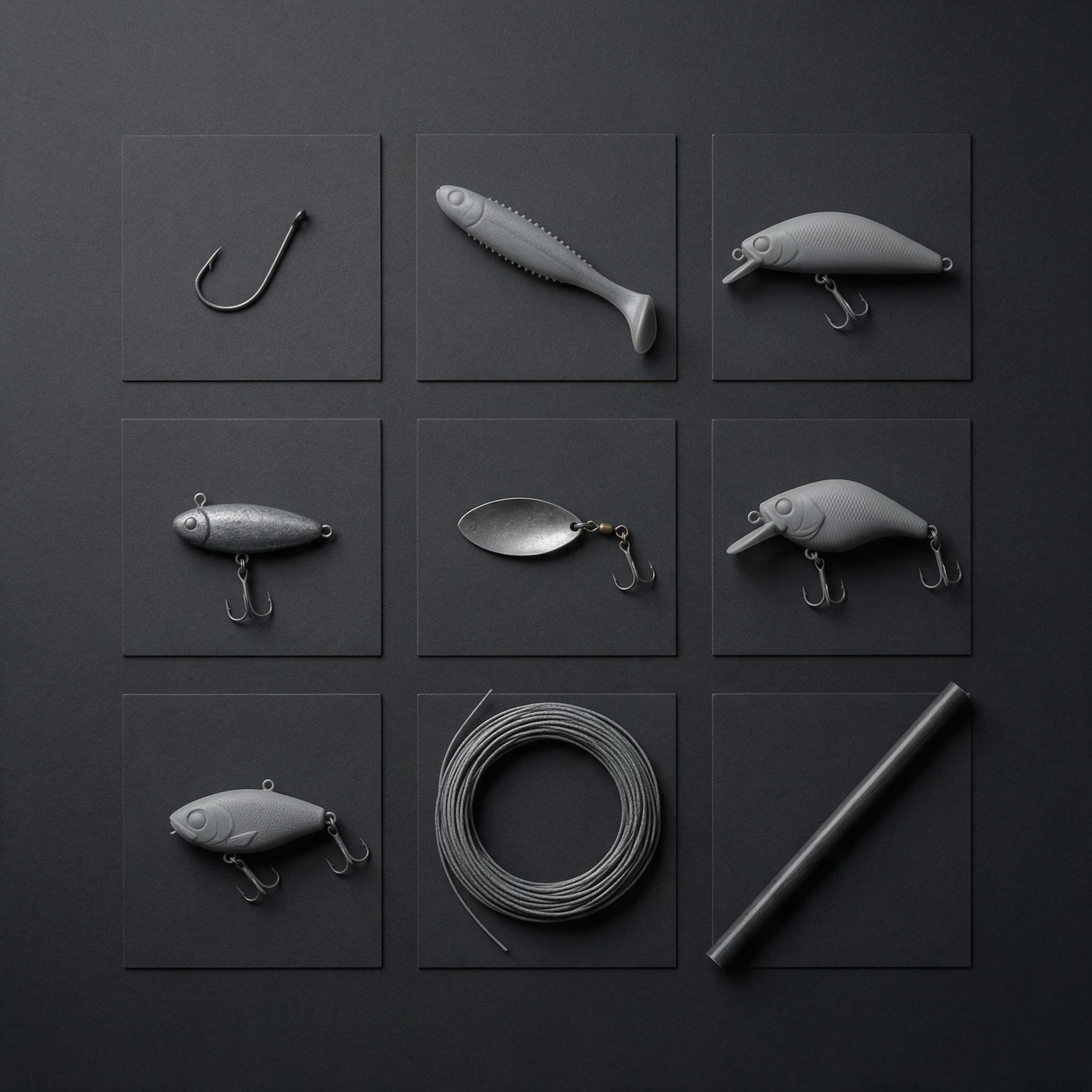
- Minnow and VIB - the two types where the order is defined by a construction field rather than a size: buoyancy class for a minnow, rattle configuration for a VIB.
- Fishing accessory - no published band. Three listings priced on bases that cannot be compared, and no line listing states the three fields a braided line is bought on.
The trade-off is consistent
Across the types where we hold enough data to see it, the same shape appears: the lowest MOQ sits at the highest unit price and the highest MOQ at the lowest.
Rods show it most clearly. The US$9.15 listing carries the highest MOQ in the sample and the US$132.55 listing the lowest. Soft lures show the same shape at a smaller scale, with the US$0.20 bait at a 1,000-piece floor and the US$3.85 bait at 100.
The reason is process, not negotiation. The two ends of each range are different manufacturing routes, not the same route at different scales. That is why asking for a lower price by raising quantity does not always work on this catalog, and why the MOQ floor is the number to plan cash around.
How that sequences a first order
If the floors differ by a factor of fifty, a first order has a natural order. Lines with a low floor commit the least cash per SKU, so they can be opened first and evaluated before the larger commitments are made.
What that sequence should be depends on the target margin and the cash available, and neither is something this catalog can answer. What it can do is make the floor visible before the buyer commits, which is the difference between a plan and a surprise.
What the first order should not do
Do not open with a category. A request for hard lures, or for lures, returns a quotation for whichever sub-type the supplier happens to hold, and the buyer never sees which one was priced.
Fix the sub-types first, using the selection table where the sub-type is chosen against a fishery. Then ask for one line per sub-type, with the unit, the quantity basis and the pack count stated on every row.
That single discipline is what makes the second and third orders comparable to the first, and it is the reason this catalog records unit errors on almost every type rather than treating them as a detail.
What this page deliberately does not say
It does not say which products sell in the US market, what margin to expect, or which type a first order should lead with. Those are commercial judgements. What it states is what our samples record, sample by sample, including the two samples of three listings that cannot support a market claim.
Sources 6 cited
- The rod sample behind the lowest MOQ floors and the widest price spread
- The fishhook sample, the largest in the catalog
- The selection table mapping sub-type to fishery
- Our editorial rules on what this site will and will not claim
- UN Comtrade — China export statistics under HS 9507, 2023-2024 (retrieved from the official API)
- Harmonized System heading 9507 (rods, hooks, reels, lures) — US HTS lookup
Every figure on this page traces to one of these. The same list is declared in the page structured data (schema.org citation) and in the Markdown twin.