
Slow-pitch metal jigs
Direct answer
Night slow-pitch jigging is covered by the saltwater press as its own technique with its own tackle and timing, and it is bought for three different fishing situations rather than as one product ladder.
Key facts
- Our sampled metal-jig listings quote US$0.97 to US$4.11 per piece at MOQ 100 to 200 pieces.
- The sample spans 20 g to 300 g, which is three different fishing situations rather than one product ladder.
- Night slow-pitch jigging is covered by the saltwater press as its own technique, with its own tackle and timing (Florida Sportsman).
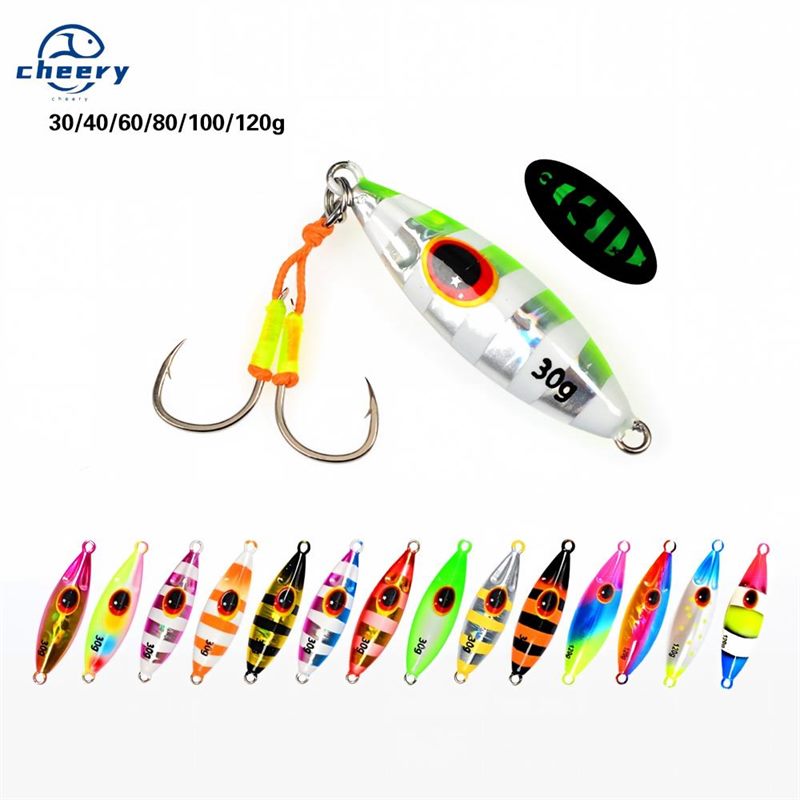
Weight decides everything on a metal jig: it sets the depth you can reach, the drift you can hold and the species you can target. The same catalog therefore has to be read as three products, not one ladder from 20 g to 300 g.
The differentiation for a buyer is not the weight, which every factory can cast. It is the finish (glow and laser are measurable), the hook and assist cord (the most commonly substituted components) and the pack format each channel asks for.
- Our sampled metal-jig listings quote US$0.97 to US$4.11 per piece at MOQ 100 to 200 pieces.
- The sample spans 20 g to 300 g, which is three different fishing situations rather than one product ladder.
- Night slow-pitch jigging is covered by the saltwater press as its own technique, with its own tackle and timing (Florida Sportsman).
- Glow and laser finishes are measurable specifications: afterglow duration and color can be tested, unlike 'looks bright'.
- Jigs are sold with or without hooks; the hook is the most commonly substituted component.
- Night jigging peaks when surface activity and tidal movement line up, which makes delivery timing part of the sale.
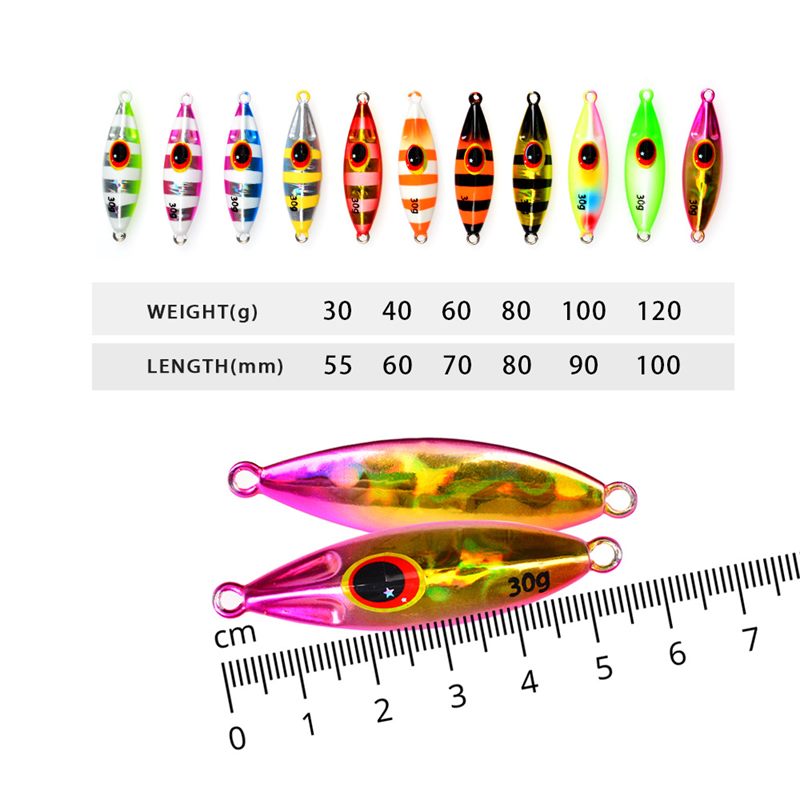
What moves the unit price
| Cost driver | Why it moves the price | How to control it in the order |
|---|---|---|
| Weight in grams | Lead is bought by weight, so a 200 g jig carries roughly ten times the metal of a 20 g one. Our sample spans 20 g to 300 g at US$0.97 to US$4.11 per piece. | Order by weight band, not by a single number. Ask for the price at two weights to see the slope before you commit to a range. |
| Body material: lead or tungsten | Tungsten is denser, so a smaller body reaches the same depth and fishes a different profile - at a multiple of the material cost. | Say which material you are quoting. If both are possible, ask for them priced as two columns, not one blended number. |
| Weight placement | A fixed rear weight and a sliding weight are different internal moulds, so they are different tooling and different assemblies. | Name the fall behaviour you want. Let the factory propose the internal design rather than specifying one you have not tested. |
| Finish: paint, foil or glow | Glow powder and multi-stage foil add process steps and raise the reject rate, which is where the cost actually goes. | Specify the finish by what it must do - glow duration, foil coverage, UV stability - not by a color name alone. |
| Hook hardware, bundled or bare | A branded assist hook and cord can add more to the unit than the jig body itself on a small weight. | State whether the quoted price includes hooks, and if it does, which model. Unbundled is not cheaper if you buy the hooks separately anyway. |
| Pack format | Individual poly bags, a retail blister and a printed card are three different labor and material costs. | Fix the retail pack at the quoting stage. Changing it after the price is agreed is where the argument starts. |
Which weight for which situation
| Weight band | Typical situation | Target species | What it changes in the product |
|---|---|---|---|
| 20-40 g | Inshore, shallow reefs, light current, shore casting | Sea bass, small amberjack, pike in freshwater | Wire gauge of the hook and the strength of the assist cord |
| 40-100 g | Boat fishing 20-60 m, moderate current | Mackerel, hairtail, bonito, yellowtail | Body finish durability and center balance |
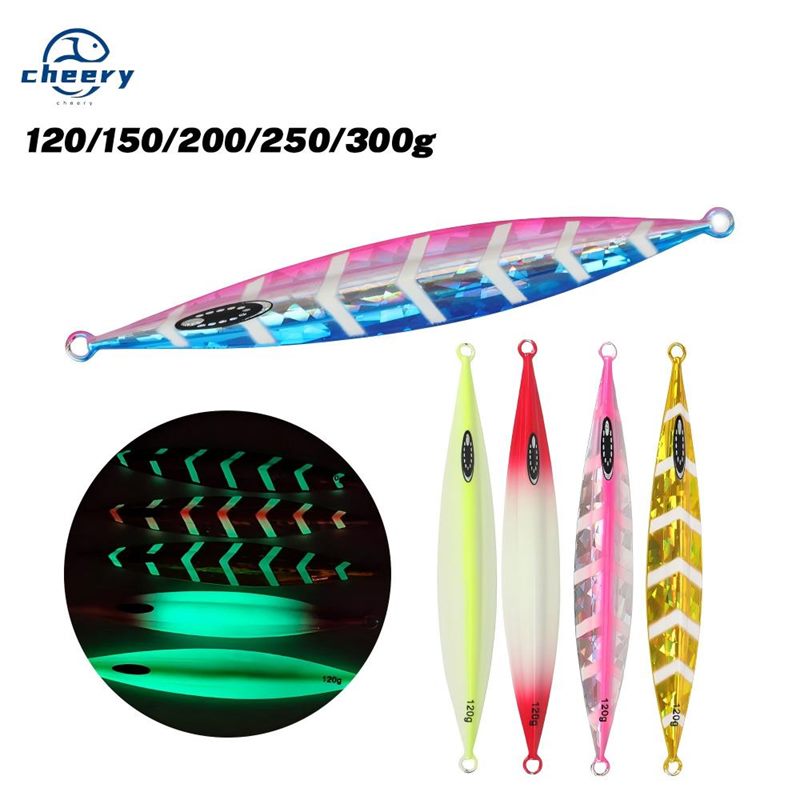
| 100-300 g | Deep water 60 m+, strong current, night jigging | Amberjack, tuna, large hairtail | Through-wire strength, paint adhesion, glow afterglow |
Finish and glow: what is actually measurable
| Finish | How it is specified | Why it decides the order |
|---|---|---|
| Glow (luminous) | Afterglow duration in minutes after a fixed charge, plus the color of the glow | Night jigging is the use case; a weak glow is a returned batch |
| Laser / holographic | Foil pattern number and coverage area, agreed from a physical sample | The most visible difference between a US$1.20 jig and a US$3.00 jig |
| UV coating | Presence and the wavelength it responds to | Sold as a low-light advantage; must be verifiable or it is a claim |
| Paint adhesion | Cross-hatch or tape test after saltwater soak | Paint flaking is the most common complaint on repeat orders |
Hooks and assist cords
| Option | What it is | What to lock in writing |
|---|---|---|
| Jig without hooks | Bare body, buyer rigs it | That the jig is supplied bare, and the eyelet dimensions |
| Single assist hook | One hook on a cord at the head or tail | Hook model, wire gauge, cord breaking strain, cord length |
| Twin assist | Two hooks, front and rear | Hook spacing and the cord length on each |
| Treble replacement | A treble on a split ring | Ring size and strength; trebles are the cheapest substitution risk |
Which channels buy which format
| Channel | Format | What it demands |
|---|---|---|
| E-commerce | Single jigs and 3-5 piece sets, weight stated in the title | Weight in grams in the title, sharp product photography, low unit cost |
| Specialist tackle retail | Singles with named hooks, weight ladder complete | Full weight ladder, credible finish, assist cords that hold |
| Boat and charter supply | Bulk singles, no retail packaging, high volume | Durability over finish, fast restock, low packaging cost |
| Private label | Custom colors and logo on the body | MOQ for the colorway, tooling for the logo, lead time for the season |
Questions buyers ask about slow-pitch metal jigs
Each question has its own page, so it can be found and cited on its own.
- What is a slow-pitch metal jig?A dense metal lure fished vertically from a boat on a slow, rhythmic lift-and-fall retrieve.
- Which species are slow-pitch jigs used for?The saltwater press describes night slow-pitch jigging as its own technique, used for amberjack, yellowtail, tuna and large hairtail in deep water.
- How much do metal jigs cost from China?Our sampled metal-jig listings quote US$0.97 to US$4.11 per piece at MOQ 100 to 200 pieces, which is a factory price basis.
- What is a normal MOQ for metal jigs?Our sample runs from MOQ 100 pieces for shore-casting weights to 200 pieces for the offshore range.
- Do jigs come with hooks?Both configurations are sold.
- How do you specify a glow finish?Specify afterglow duration in minutes after a fixed charge time, plus the color of the glow, and ask for the test to be repeated on a production sample.
- When is the buying season for jigs?Night offshore jigging peaks in autumn and winter in most northern-hemisphere markets, when surface activity and tidal movement line up.
- Which finish should a value-tier jig use?Laser and holographic foil over painted bodies is the usual value tier, with plain paint below it and true glow above it.
What to send for a comparable quote
| Field | Why it changes the price |
|---|---|
| Weight in grams | The single most important field; it decides depth, drift and species |
| Length and profile | Long, short or center-balanced; profile decides the fall action |
| Body material | Lead alloy versus zinc; zinc is lighter for the same size and priced differently |
| Finish | Glow, laser, UV or painted; each has its own cost and its own test |
| Glow afterglow | Minutes after a fixed charge, plus the glow color |
| Hook configuration | Bare, single assist, twin assist or treble; with the hook named by model |
| Assist cord | Breaking strain, length and color |
| Eyelet and through-wire | Wire diameter and pull strength for the larger weights |
| Pack format | Single, 3-5 piece set or bulk; retail card or poly bag |
| Target market | Drives labeling and compliance |
| Price basis | FOB port or EXW factory, plus the order quantity it applies to |
What to agree in writing, and the tolerance to name
| Field | What the order has to state | Tolerance or standard to name |
|---|---|---|
| Weight in grams | Target weight per jig, and at which point it is measured | State the band you will accept and the method: per piece, dry, before hardware. Weighing rigged jigs is a different number. |
| Plating and saltwater hardware | Corrosion resistance of hooks, rings and any plated part | Name a salt-spray standard - ISO 9227 or ASTM B117 - and the hours you require. Without hours stated, the test says nothing. |
| Glow finish | How long the finish stays visible after charging, and how that is measured | Agree the charge time, the light source and the decay threshold. Glow has no single standard, so the measurement conditions are the specification. |
| Hook, ring and assist cord | Hook maker, wire gauge, cord length and knot | Name the hook and the wire gauge. An unnamed strong hook is the most common substitution on a repeat order. |
| colorway repeatability | The standard the second batch is measured against | A physical master sample you keep, or a named color standard, plus a stated tolerance. A photo is not a standard. |
| Paint adhesion and finish durability | How the finish survives handling and saltwater | Agree an adhesion test method and a visual limit for chips, rather than describing the finish as durable. |
| Pack count and carton | Pieces per pack, packs per carton, and the label content | State the count exactly and name an inspection standard for it - AQL to ISO 2859-1 - so a short count is a defect, not a discussion. |
What we have not verified
- Unit volumes by market: we publish no figure for jig consumption per market; the technique coverage is qualitative.
- Retail price by channel: we have not run a retail price survey, so no margin table is published here.
- Hook brand equivalence: hook models from different makers are not interchangeable, and we publish no equivalence table.
- Zinc versus lead legality by market: restrictions differ, and the buyer's customs broker decides the classification.
Where this record leads
- Sampled metal jigs listings - reference prices and MOQ per listing.
- Specification builder - turn these fields into a spec sheet you can send.
- Reference price bands - the band this record sits in, with its unit stated.
- The sourcing playbook - the process these questions sit inside.
- US and EU compliance - what has to be true before the shipment clears.