
Lipless vibration baits (VIB): body, rattle, weight, MOQ
The trade treats VIB as the wider word: a vibe lure is described as looking like a lipless crankbait with the line tie on the top and treble hooks in the front and back.
- The trade treats VIB as the wider word. Sport Fishing Mag, quoting Nomad Tackle, describes a vibe lure as looking like a lipless crankbait with the line tie on the top and treble hooks in the front and back, and the same article notes that the style covers soft baits, hard baits and metal blade baits, with saltwater versions through-wired to hold the lure together (Sport Fishing Mag).
- Rattle design is a choice with published reasoning behind it. Rapala's article on its Clackin' range says multiple balled chambers emulate a volume of forage such as a school of shiners or shad, while the single clobbering clank of its own Clackin' family comes from one larger chamber, which the article links to a single large baitfish or crawfish and concludes is intended for big fish; the Clackin' Rap uses an external metal-to-metal chamber (Rapala).
- Rapala publishes the Rippin' Rap as a lipless, tall body profile with a loud BB rattle system, sinking, in a ladder of 5 cm / 9 g, 6 cm / 14 g and 7 cm / 24 g, which is roughly 1.8 grams per centimetre at the smallest rung and 3.4 at the largest (Rapala).
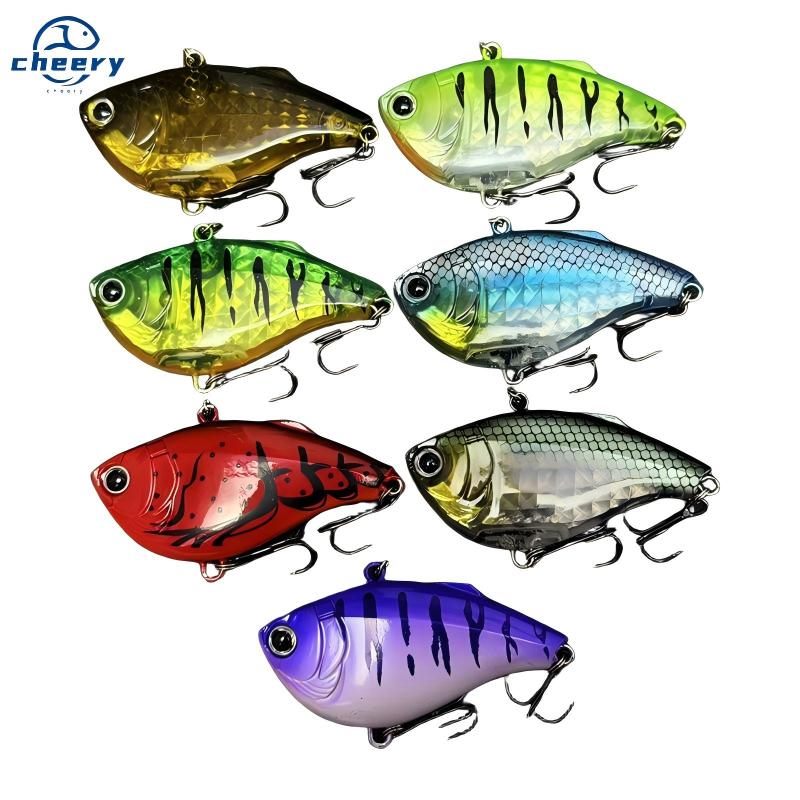
A vibration bait is the densest lure in a casting range for its length, and that density is the product. The published descriptions agree on the form: Sport Fishing Mag describes a vibe lure as a lipless crankbait with the line tie on the top and treble hooks front and back, and notes the same family covers soft baits, hard baits and metal blade baits. Rapala publishes its Rippin' Rap from 5 cm / 9 g to 7 cm / 24 g, so weight per centimetre nearly doubles across three rungs of one ladder, while Berkley's Jack 7 packs 3/4 ounce into 2 3/4 inches with tungsten. Two baits of the same length are not the same bait.
The commercial consequence is that a VIB quote has more moving parts than its silhouette suggests. The rattle is a moulded component with its own tooling and its own theory behind it - Rapala contrasts one large metal-to-metal chamber with multiple small balled chambers - and each length rung carries two different hook sizes. Sonar has pulled the category towards vertical work: the Jack 7 review describes the bait being dropped on fish seen on forward-facing sonar and steered in place. Low minimums make that testable. Our sampled listings quote US$0.24 to US$2.98 per unit at MOQ 50 to 500 pieces, a factory price basis.
- The trade treats VIB as the wider word. Sport Fishing Mag, quoting Nomad Tackle, describes a vibe lure as looking like a lipless crankbait with the line tie on the top and treble hooks in the front and back, and the same article notes that the style covers soft baits, hard baits and metal blade baits, with saltwater versions through-wired to hold the lure together (Sport Fishing Mag).
- Rattle design is a choice with published reasoning behind it. Rapala's article on its Clackin' range says multiple balled chambers emulate a volume of forage such as a school of shiners or shad, while the single clobbering clank of its own Clackin' family comes from one larger chamber, which the article links to a single large baitfish or crawfish and concludes is intended for big fish; the Clackin' Rap uses an external metal-to-metal chamber (Rapala).
- Rapala publishes the Rippin' Rap as a lipless, tall body profile with a loud BB rattle system, sinking, in a ladder of 5 cm / 9 g, 6 cm / 14 g and 7 cm / 24 g, which is roughly 1.8 grams per centimetre at the smallest rung and 3.4 at the largest (Rapala).
- Berkley's Jack 7 lipless crankbait is published at 2 3/4 inch and 3/4 ounce, sinking, with a knife-blade-style back and tungsten internal weighting; the review says it is used vertically on sonar targets, can be dropped on fish under forward-facing sonar and controlled precisely because it sinks fast and tracks stably, and handles water to 40 feet (Bassmaster).
- Nomad Tackle builds its Vertrex Max 75 soft vibe, published at 3 inches and 2/5 oz, from TPE Ultra-Tough material, says it sinks level and straight, that a deeper body shape creates more vibration at slower speeds, that its sink rate is around twice that of the Vertrex Swim, and that it ships with BKK hooks fitted (Nomad Tackle).
- Our sampled listings quote US$0.24 to US$2.98 per unit at MOQ 50 to 500 pieces - a factory price basis, not a retail price; the six rows typed VIB in that sample run from a zinc alloy bait at US$0.24 to US$0.38 per piece at MOQ 500 to a vibrating sinking lure at US$2.50 per bag at MOQ 100 bags, and the 95 and 115 mm TPE fork-tail vibration in the same sample is quoted at US$2.98 at MOQ 50 (our sampled listings).
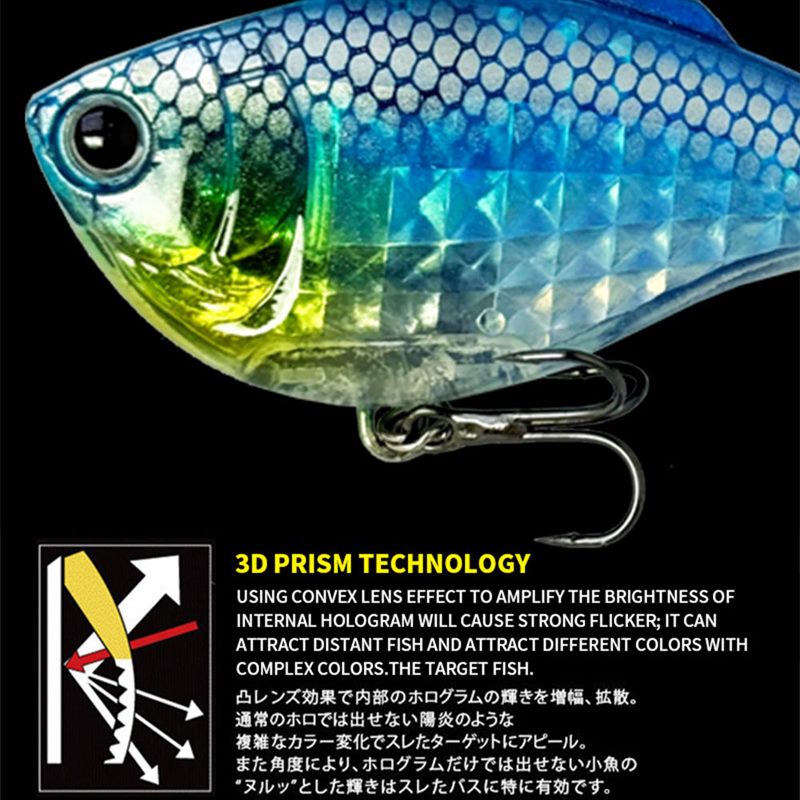
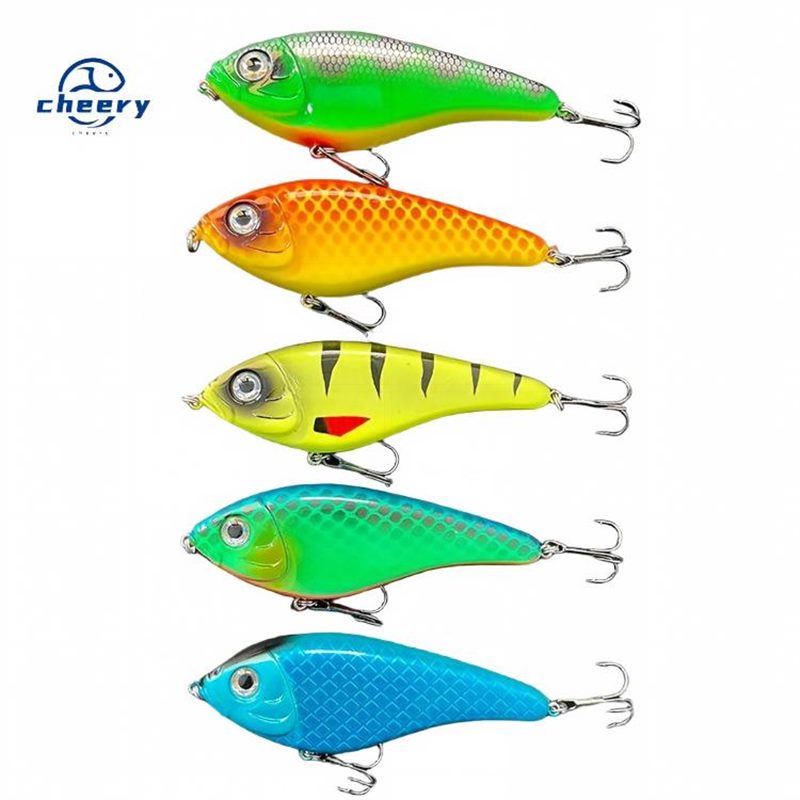
What moves the unit price
| Cost driver | Why it moves the price | How to control it in the order |
|---|---|---|
| Body material route | Hard plastic, soft TPE and a printed body sit on different tooling, different cycle times and different scrap rates. | Pick the route before the price conversation. Asking for one price across two routes produces a number that is wrong for both. |
| Weight-to-length ratio | The same 40 mm body at two weights is two mouldings with different internal chambers, not one product at two prices. | Quote by the ratio you fish, not by the length alone. Ask which ratio the sampled price refers to. |
| Rattle chamber design | A single chamber, a multi-ball chamber and a sealed body are three tooling builds with different assembly labor. | Say what the bait must sound like and let the factory propose the chamber. Naming a chamber design you have not tested is how a run gets rejected. |
| Weighting material | Tungsten, lead and steel weight the same body at very different material costs and different densities. | State the material, and ask for the sink rate consequence rather than only the weight in grams. |
| Hooks and split rings | Promotional hooks, unbranded rings and a branded hardware set are three different line items that look identical on a photo. | Name the front and rear hook, the gauge and the ring size. This is the first place a quote is quietly made cheaper. |
| Paint, foil and eyes | Foil, a secondary color pass and 3D eyes are separate operations, each with its own reject rate. | Specify the number of color passes and the eye type. color names alone do not price. |
What the VIB category actually contains
| Construction | What the published description says | What to lock in writing |
|---|---|---|
| Hollow plastic vibration bait | A vibe lure is described as looking like a lipless crankbait with the line tie on top and treble hooks front and back (Sport Fishing Mag); Rapala sells the Rippin' Rap as a lipless, tall body profile with a loud BB rattle system (Rapala) | Body length, body weight, chamber type and the two hook sizes, front and rear |
| Soft vibe | The same article notes the style can be soft baits as well as hard baits (Sport Fishing Mag); Nomad Tackle moulds its Vertrex Max from TPE, fits BKK hooks and states it sinks level and straight (Nomad Tackle) | TPE or PVC compound, tail shape, rigging method, and whether the bait ships rigged or loose |
| Metal blade bait | The style is described as covering metal blade baits as well, worked by vibrating on the fall and on the retrieve (Sport Fishing Mag); our sampled listings include a zinc alloy vibration bait priced from US$0.24 per piece at MOQ 500 (our sampled listings) | Alloy and plating, plus whether the harness is wire-through or moulded into the body |
Rattle and chamber design
| Chamber choice | What the source says | What to specify on the order |
|---|---|---|
| One larger chamber | Rapala's article says the lone clobbering clank of its Clackin' family comes from a single, larger source, compared with a big crawfish or a large baitfish among rocks, and that single-chamber baits are intended for big fish (Rapala) | Chamber volume, ball material and count, and whether the chamber is metal-to-metal |
| Multiple small chambers | The same article says multiple balled chambers emulate a volume of forage such as a school of shiners or shad, and presents the whole single-versus-multiple comparison as theory (Rapala) | Ball count and diameter, chamber wall thickness, and a sound sample the buyer approves before production |
| External metal-to-metal chamber | Rapala describes the Clackin' Rap's external metal-to-metal chamber as banging a signature cadence, part of a body given a translucent finish with internal holographic foil (Rapala) | Chamber material and its plating, and the weld or seal that keeps water out over a season |
Weight-to-size ratio on published ladders
| Published bait | Published length and weight | What the ratio changes |
|---|---|---|
| Rapala Rippin' Rap, small rungs | 5 cm at 9 g and 6 cm at 14 g, both sinking (Rapala) | About 1.8 to 2.3 grams per centimetre, light enough for a slow fall and shallow cover |
| Rapala Rippin' Rap, top rung | 7 cm at 24 g, sinking, with a variable running depth (Rapala) | About 3.4 grams per centimetre, roughly double the smallest rung, buying a fast fall and vertical work |
| Berkley Jack 7 | 2 3/4 inch at 3/4 ounce, sinking, with tungsten internal weighting and a knife-blade-style back (Bassmaster) | Density held inside a short body, which is a weighting-material cost that has to be quoted rather than assumed |
Hooks and hardware on a vibration bait
| Hardware point | What the source publishes | What to specify |
|---|---|---|
| Two treble sizes on one bait | Rapala's Rippin' Rap table lists No. 8 and No. 10 on the 5 cm model, No. 6 and No. 8 on the 6 cm and No. 4 and No. 6 on the 7 cm, all VMC black nickel (Rapala) | Front and rear hook size, wire gauge and shank length for every length rung ordered |
| Grip-style belly hook and factory hook grade | Rapala's rattle article notes a VMC SureSet belly hook on the Clackin' Rap (Rapala), and a Bassmaster review records that the test bait's factory hooks were sharp enough that no swap was needed (Bassmaster) | Hook brand or grade, hook finish, and whether hooks ship rigged on the bait or bagged loose |
| Through-wired harness | Saltwater versions of the vibe lure are described as through-wired to hold the lure together (Sport Fishing Mag); Nomad Tackle states its soft vibe is balanced so it sinks level and does not spin on the drop (Nomad Tackle) | Whether wire runs the full body length, and how the line tie and both hook hangers anchor to it |
Questions buyers ask about lipless vibration baits (VIB): body, rattle, weight, MOQ
Each question has its own page, so it can be found and cited on its own.
- How does a VIB differ from a lipless crankbait?The trade treats VIB as the wider word and lipless crankbait as one shape inside it.
- What do the rattle chambers inside a vibration bait actually do?They are the bait's sound, and the design is a choice rather than a default.
- How does the weight-to-size ratio change as a vibration bait gets longer?It rises, and it rises fastest at the top of the ladder.
- Why is a vibration bait fished vertically, and what did sonar change?A lipless bait sinks on a tight line, so it can be dropped straight down and worked with small lifts instead of being cast and retrieved.
- What hooks should a vibration bait ship with?Two trebles of different sizes, and the sizes should be published for each length.
- Should the body be hard plastic, soft TPE or metal?Each construction buys a different fall and a different price.
- How is a vibration bait priced from a Chinese factory?Our sampled listings quote US$0.24 to US$2.98 per unit at MOQ 50 to 500 pieces - a factory price basis and nothing more; it excludes freight, duty, packaging and every margin after the factory gate.
- Why does a low MOQ make a vibration bait a trial-order product?Because the vibration baits in our sample start at MOQ 50 to 100 pieces, a buyer can test a body, a rattle and a color before committing to tooling or a season's stock.
What to send for a comparable quote
| Field | Why it changes the price |
|---|---|
| Body length in millimetres or inches | The first axis of the ladder and the field that fixes mould size, packaging and which hook sizes fit |
| Body weight in grams or ounces | Published beside length on every brand ladder, and a heavier body means more material and more ballast |
| Weight-to-length ratio and sink rate | Two bodies of the same length at 9 g and 24 g are different products; density is what the fast fall and the vertical presentation are bought with |
| Rattle chamber type and ball count | A chamber is its own moulded component and its own assembly step, so single, multiple and external chambers are three different costs |
| Body material | Hollow ABS, TPE soft body and solid zinc alloy each carry a different tooling cost, a different fall and a different unit price |
| Weighting material | Tungsten, lead, zinc and brass differ in density and in material cost per gram, and the choice is quoted, not assumed |
| Internal harness | A full wire-through body costs more wire and assembly time than moulded-in hangers, and it is the part that survives a fish |
| Hook size, gauge and shank, front and rear | Published ladders list two different hook sizes on one bait, so each position is a separate line on the quotation |
| Split rings | Ring diameter and strength rating are quoted separately, and the ring is where an upgrade or a downgrade quietly happens |
| Paint, foil and eyes | color count, holographic foil, translucent finishes and 3D eyes each add a process step, and color is usually the largest driver of SKU count |
| Pack format, order quantity and price basis | One bait per box or a bagged pack, at a stated MOQ and FOB or EXW basis; a VIB price without those fields cannot be compared with another quote |
What to agree in writing, and the tolerance to name
| Field | What the order has to state | Tolerance or standard to name |
|---|---|---|
| Body weight | Target weight per bait before or after hardware | State the band and the measurement point. A bait weighed with hooks is heavier than the catalog figure. |
| Sink rate | How fast the bait falls in a stated water condition | Agree the test conditions - fresh or salt water, line, depth - or the number is not comparable between factories. |
| Plating on hooks and rings | Corrosion resistance for saltwater use | Name a salt-spray standard - ISO 9227 or ASTM B117 - and the hours required. |
| Hook and ring specification | Hook model, wire gauge, front and rear, ring size | Name them on the purchase order. Split rings in particular are replaced with a lighter gauge without notice. |
| Paint and foil durability | Adhesion and chip limits after handling | Agree an adhesion test method and a visual limit, rather than the word durable. |
| Rattle chamber consistency | The sound and the ball count across the batch | State the ball count and accept a sampled check, since the sound itself cannot be specified numerically. |
| colorway and pack count | The color standard and the pieces per pack | A master sample or named color standard, plus an exact pack count inspected to AQL ISO 2859-1. |
What we have not verified
- Market size and unit volumes for vibration baits: no sourced figure was found for any market, and none is invented here.
- Retail prices, margins and sell-through for VIB lures: we publish no retail survey, so any retail figure seen on a listing belongs to that listing.
- Whether one rattle chamber design out-fishes another: Rapala presents the single-versus-multiple chamber comparison as theory, and no comparative catch data was found.
- Measured sound pressure, frequency or decibel figures for any rattle chamber: no measured data is published here, and none is claimed.
- Weight-for-weight equivalence between tungsten, lead, zinc and brass in the same body volume: no sourced conversion table is published here, and classification of the weighting material is the buyer's customs broker's decision.
Where this record leads
- Sampled hard lures listings - reference prices and MOQ per listing.
- Specification builder - turn these fields into a spec sheet you can send.
- Reference price bands - the band this record sits in, with its unit stated.
- The sourcing playbook - the process these questions sit inside.
- US and EU compliance - what has to be true before the shipment clears.
Related reading
- Why does a low MOQ make a vibration bait a trial-order product?
- How does the weight-to-size ratio change as a vibration bait gets longer?
- How does a VIB differ from a lipless crankbait?
- How is a vibration bait priced from a Chinese factory?
- What do the rattle chambers inside a vibration bait actually do?
- Should the body be hard plastic, soft TPE or metal?