
Fork-tail soft plastics: the multi-pack value tier
A fork tail sold by the pack is specified by material before it is specified by shape.
- Rapala's own material guide splits its soft baits between a PVC plastisol formula it describes as more resilient and dense than typical plastisol, with detailed colors and tails that sit neutral or bent over on the bottom, and a Super TPE it describes as extremely durable, stretchy, buoyant and temperature tolerant, and it lists the PVC baits as phthalate-free (Rapala).
- Westin publishes one Ned Worm model in a super-elastic floating TPR, sold as 7 pieces at 7 cm / 3 g and 6 pieces at 9 cm / 5 g, listed in eight colors plus dark-water and clear-water mixes, with the warning that TPR should not be stored with other lures (Westin).
- Bassmaster's account of soft-plastic density records that stickworms are typically moulded from a dense plastic infused with salt to increase weight and sink rate, that salt entered soft plastics as a taste additive with the Gene Larew Salt Craw in 1983, and that denser plastic tends to harden the bait while softer, less dense plastic sinks more slowly (Bassmaster).
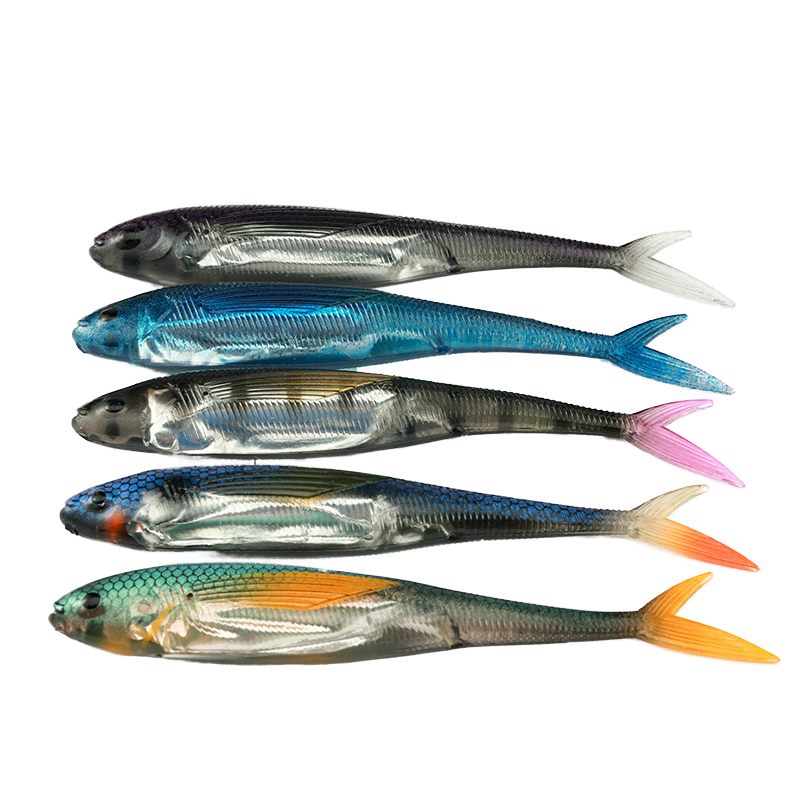
Fork-tail soft plastics are the value tier of the lure wall, and they are sold by the pack rather than by the bait. That single fact reorganises the product: a body that costs cents at the factory reaches the angler as a five- or six-piece bag, so the pack count, the color count and the bag itself carry as much of the price as the plastic does. The material decision behind it is narrower than it looks. Rapala's own material guide splits its soft baits between a PVC plastisol formula, which it describes as more resilient and dense than typical plastisol with detailed colors and tails that sit neutral or bent over on the bottom, and a Super TPE it describes as extremely durable, stretchy, buoyant and temperature tolerant. Neither is the value answer by itself; the tail you want decides the material.
Two things then decide whether the tier makes money. The first is what is inside the plastic. Bassmaster's account of density is blunt: stickworms are moulded from a dense plastic infused with salt to add weight and sink rate, salt arrived in soft plastics in 1983 as a taste additive, and a denser plastic tends to harden the bait while a softer, less dense one sinks more slowly. Salt is therefore a priced ingredient, not a footnote. The second is the pack. Westin sells one Ned Worm as seven pieces at 7 cm and six pieces at 9 cm across eight colors, and RinPac's packaging guide makes the consequence plain: a soft-bait pouch has to be fitted around the filled product because baits settle and overlap, so piece count sets the pouch. Pack count and color count are therefore channel decisions - a two-piece blister for a pegboard and a twelve-piece bag for an online bundle are not the same product, even when the bait inside is identical.
- Rapala's own material guide splits its soft baits between a PVC plastisol formula it describes as more resilient and dense than typical plastisol, with detailed colors and tails that sit neutral or bent over on the bottom, and a Super TPE it describes as extremely durable, stretchy, buoyant and temperature tolerant, and it lists the PVC baits as phthalate-free (Rapala).
- Westin publishes one Ned Worm model in a super-elastic floating TPR, sold as 7 pieces at 7 cm / 3 g and 6 pieces at 9 cm / 5 g, listed in eight colors plus dark-water and clear-water mixes, with the warning that TPR should not be stored with other lures (Westin).
- Bassmaster's account of soft-plastic density records that stickworms are typically moulded from a dense plastic infused with salt to increase weight and sink rate, that salt entered soft plastics as a taste additive with the Gene Larew Salt Craw in 1983, and that denser plastic tends to harden the bait while softer, less dense plastic sinks more slowly (Bassmaster).
- Outdoor Canada's interview with a soft-plastic manufacturer states that the majority of soft plastics are made from plastisol, a vinyl plastic whose hardness is set by the ratio of resins to plasticisers, that raw plastisol catalyses at around 320 degrees F and cures for at least 24 hours, and that a swimbait needs a firmer tail section or it will not roll properly, while a tail that is too stiff makes the lure roll onto its side (Outdoor Canada).
- RinPac's lure-packaging guide sets a flexible hanging pouch that follows the packed profile and can reclose against a blister card or clear rigid pack that holds a defined cavity for hook control, and states that a soft-bait pouch must be fitted around the filled product because baits settle and overlap, so piece count and settled depth set the pouch size (RinPac).
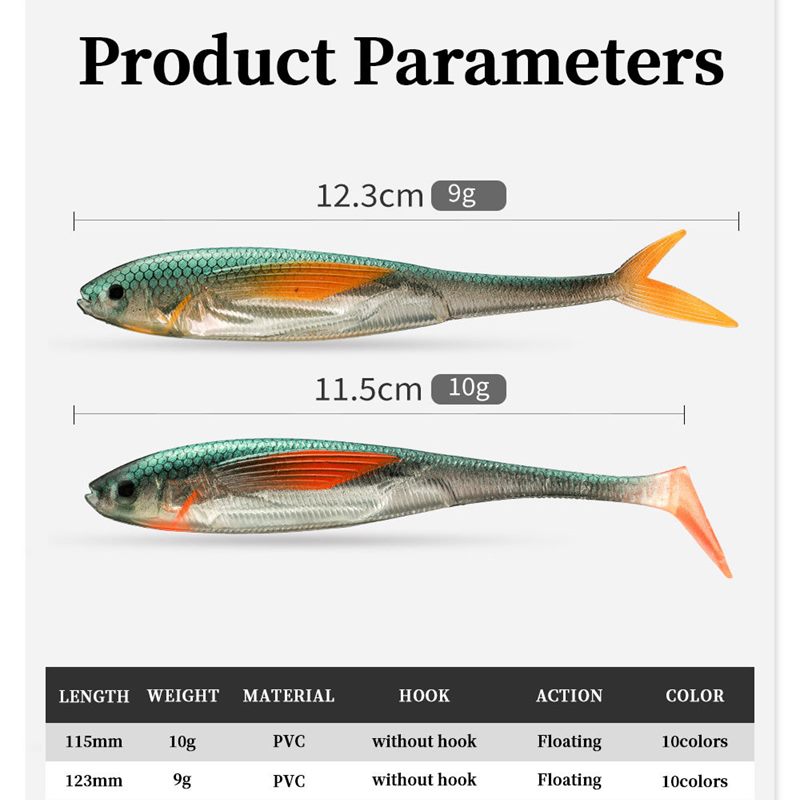
- Our sampled listings quote US$0.20 to US$3.85 per piece for soft lures at MOQ 50 to 1,000 pieces - a factory price basis; within that sample our printed 12 cm 3D PVC fork tail is US$0.67 per piece at MOQ 500, our 95 mm and 115 mm TPE fork-tail vibe is US$2.98 at MOQ 50, our 3D-printed PVC flying fish is US$3.75 to US$3.85 at MOQ 100, our needle-tail worm is US$0.60 at MOQ 200 and our 18.5 cm T-tail is US$1.55 to US$1.59 at MOQ 100.
What moves the unit price
| Cost driver | Why it moves the price | How to control it in the order |
|---|---|---|
| Material route: PVC, plastisol, TPE or a printed body | Each route has a different tooling cost, cycle time and scrap rate - and a different compliance profile. | Choose the route first. A very cheap PVC body and a TPE body of the same shape are not the same product in the EU. |
| Plastisol formula and durometer | Hardness decides durability and action, and a different durometer is a different mix, not a setting. | State the durometer you want, or send a reference bait. Asking for soft is not a specification. |
| Salt content and grade | Salt adds weight and density, and it is charged by the proportion used rather than by the word salted. | Name the proportion. Salt content is also what makes a cheap bait tear. |
| Tail geometry and taper | Tail thickness and taper decide how the bait moves at low speed; they are mould geometry, not finishing. | Describe the action at slow retrieve and approve a sample. A drawing will not show it. |
| color count per pack | Every additional color in a multi-pack is a separate moulding run and a separate packing step. | Fix the color count. Value packs are priced on color count more than on anything else. |
| Pack count and format | On this category the pack count is the product: it sets the retail price point and the unit cost together. | Decide the count and the format together, and check the count against your retail price point before quoting. |
Material route: PVC, TPE or a printed body
| Material route | What the published description says | What it changes in a multi-pack |
|---|---|---|
| PVC plastisol | Rapala describes its PVC formula as more resilient and dense than typical plastisol, with detailed colors and tails that sit neutral or bent over on the bottom, and lists those baits as phthalate-free (Rapala) | The widest color range at the lowest material cost, but the buyer carries the chemical file, because a PVC bait is where the phthalate and cadmium alerts land (EU Safety Gate INFO/00134/24) |
| TPE or TPR | Rapala describes Super TPE as extremely durable, stretchy, buoyant and temperature tolerant; Westin builds its Ned Worm from a super-elastic floating TPR and warns that TPR should not be stored with other lures (Rapala, Westin) | More material cost per bait bought back as stretch, tail memory and a bait that survives a hot car, plus a storage instruction that belongs on the bag |
| 3D-printed body or printed mould | Our catalog carries a 3D-printed PVC flying fish soft lure quoted at US$3.75 to US$3.85 per piece at MOQ 100 (our sampled listings) | A print route suits short runs and shapes a mould cannot justify, but at that unit price it sits at the top of our soft-lure sample rather than in the value tier |
Tail geometry and what it does to the action
| Tail type | How the bait moves | What to fix on the order |
|---|---|---|
| Fork or split tail | The two legs load and unload against each other, so the tail keeps working on a straight steady retrieve as well as on the drop (our printed 12 cm 3D PVC fork tail listing) | Fork depth, leg thickness and whether the split is moulded in or cut after demoulding, because a cut split adds a trimming step and a person |
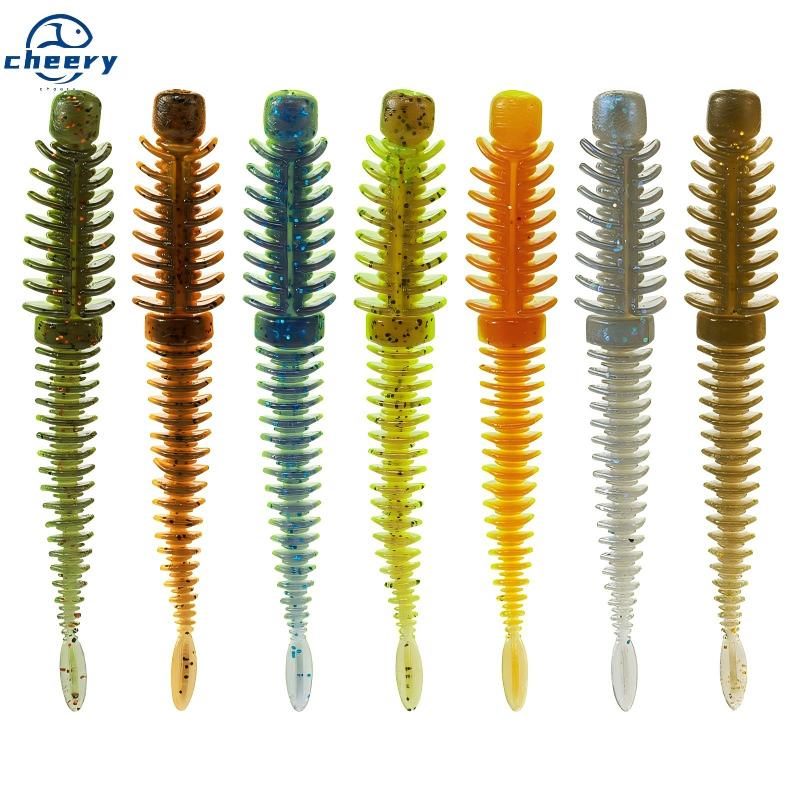
| Needle or straight tail | An unsplit thin tail has the least water resistance, so the bait is worked on the drop and on the shake rather than on a fast wind (our anti-thread needle-tail worm listing) | Tail diameter and taper, and whether the bait carries an anti-thread collar, since a thin unsplit tail tears first in a bag |
| T-tail or broad paddle | A broad tail sweeps side to side, and the maker's caution is that a swimbait needs a firmer tail section to roll and a too-soft tail leaves it with no action, while a too-stiff tail rolls the lure onto its side (Outdoor Canada) | Tail shore hardness as well as tail shape, because on a paddle the formula and the cut are one decision (our 18.5 cm T-tail listing) |
Salt, density and what is actually in the bait
| Formulation choice | What the source says it does | What it changes in the quote |
|---|---|---|
| Unsalted, soft pour | Bassmaster records that the original thin-walled tube carried no salt, and that softer, less dense plastics sink more slowly and are preferred for finesse work (Bassmaster) | The lowest ingredient cost and the slowest fall, bought back as a bait that tears up sooner and needs more of them per session |
| Salt-infused, dense pour | The same piece states that stickworms are typically moulded from a dense plastic infused with salt to increase weight and sink rate, and that denser plastic tends to harden the bait (Bassmaster) | Salt is bought by weight, so it is a priced ingredient in the formula rather than a feature, and the harder bait changes hook penetration |
| Texture and durometer | Outdoor Canada's makers say a bait can be made as soft or hard as you like by changing the ratio of resins to plasticisers, that a soft stickbait reads as a nightcrawler while a firmer tube reads as a crayfish, and that fish hold on longer when the feel matches the forage (Outdoor Canada) | Durometer is a separate order line from salt content, and a buyer who specifies only grams of weight has not specified the bait at all |
Pack count, color count and the channel
| Pack decision | What the trade source says | What it demands from a factory |
|---|---|---|
| Pieces per bag or card | Westin sells one Ned Worm model as 7 pieces at 7 cm and 6 pieces at 9 cm; RinPac's guide says a soft-bait pouch is fitted around the filled product because baits settle and overlap, so piece count and settled depth set the pouch (Westin, RinPac) | Piece count is quoted together with the pouch or card size, because the same 12 cm bait in a 2-pack and a 12-pack is two SKUs with two pack costs |
| Blister card or poly bag | RinPac sets a flexible hanging pouch that follows the packed profile and can reclose against a blister card or clear rigid pack holding a defined cavity for hook control, and notes rigid formats add depth and assembly steps (RinPac) | A blister adds a printed card, a die-cut and a sealing step, while a poly bag adds almost nothing, so the format is a channel decision before it is a cost decision |
| color count inside the pack | Westin lists its Ned Worm in eight colors at each of two lengths, and RinPac's brief asks a buyer for unit count and SKU count together (Westin, RinPac) | Eight colors at two lengths is sixteen SKUs from one mould, so a mixed-color bag is how a value tier keeps the SKU count and the fill labor under control |
Questions buyers ask about fork-tail soft plastics: the multi-pack value tier
Each question has its own page, so it can be found and cited on its own.
- What makes a fork tail a fork tail, and what does the fork do?A fork tail is a soft plastic whose tail is split into two legs rather than ending in a point or a broad paddle.
- PVC plastisol, TPE or a 3D-printed body: which should a value multi-pack use?Start from the tail, not the price.
- How does salt content change a soft plastic, and how should it be specified?Salt is a priced ingredient before it is a fishing feature.
- How many colors should one value multi-pack carry?Fewer than the wall suggests.
- What pack counts should a value-tier order use?Match the count to the shelf rather than to the angler's habit.
- Blister card or poly bag?RinPac's packaging guide frames the choice as a trade between a flexible hanging pouch that follows the packed profile and can reclose, and a blister card or clear rigid pack that holds a defined cavity for hook control, noting that rigid formats add depth and assembly steps.
- How is a fork-tail multi-pack priced from a Chinese factory?Our sampled listings quote US$0.20 to US$3.85 per piece for soft lures at MOQ 50 to 1,000 pieces, which is a factory price basis and nothing more: it excludes freight, duty, artwork, the bag or card itself and every margin after the factory gate.
- What compliance risk sits behind a very cheap PVC soft bait?PVC is where the chemical alerts land.
What to send for a comparable quote
| Field | Why it changes the price |
|---|---|
| Body material | PVC plastisol, TPE or TPR, or a printed body; the material sets the resin and plasticiser cost, the stretch and tail memory, and which chemical file the buyer has to carry |
| Plastisol formula and durometer | Hardness is set by the ratio of resins to plasticisers, so a softer pour is a different formula, a different cure and a different price rather than a different shape |
| Salt content and grade | Salt is bought by weight and mixed into the pour, so it appears twice: as an ingredient cost and as the reason the finished bait is denser and sinks faster |
| Body length and weight in cm and grams | Length sets the mould, the pack size and the rod and hook the angler rigs it on, and weight is quoted beside it, so a heavier bait at the same length means more material or more salt |
| Tail geometry | Fork, needle or broad paddle; the shape decides how the bait is fished, and it is either a mould feature or an extra cutting and trimming operation |
| Tail thickness and taper | A tail that is too soft has no action and a tail that is too stiff rolls the lure onto its side, so tail section is a mould and formula decision rather than a cosmetic one |
| color count and colorway | Every color is a separate pour, a separate clean-down between colors and a separate SKU, which makes color count the largest single driver of SKU count in the category |
| Scent, UV and glitter additives | Scent, garlic, UV pigment and metal flake are added before the pour, so each one is another ingredient line and another chance of a color that will not repeat |
| Pack count | 2, 5, 6 or 12 pieces per pack changes the bag or card size, the fill time, the freight cube and the price point the retailer can put on the peg |
| Pack format | Blister card, rigid clear box or poly bag; a blister needs a printed card, a die-cut and a sealing step, while a poly bag is the cheapest way to present a bait with no exposed hook |
| Order quantity and price basis | MOQ, pack count and FOB or EXW basis have to be quoted together, because a soft-lure unit price without those fields is not comparable with another quote |
What to agree in writing, and the tolerance to name
| Field | What the order has to state | Tolerance or standard to name |
|---|---|---|
| Body material | The exact material, named, and whether recycled content is claimed | Name the material and, where the market requires it, the recycled proportion. A generic soft plastic claim is not a specification. |
| Durometer | The hardness of the finished bait | State the durometer with a band, and ask how it is measured on a finished bait rather than on the mix. |
| Salt content | Whether the body is salted, and the proportion | Name the proportion and accept a sampled check, because salt is invisible in the finished bait. |
| Body length and weight | Target length and weight, with both measured | State both with bands. In a multi-pack, weight variation between colors is the usual complaint. |
| color consistency across the pack | How closely the colors in one pack match each other | A retained master set, or named color standards per color, with a stated tolerance. |
| Pack count | Pieces per pack and packs per carton, exactly | Exact counts inspected to AQL ISO 2859-1. In this category the count is the product, so it is the first thing to verify. |
| EU material compliance | Which restriction the material is declared against | Name the restriction that applies to your market - EU chemical rules for plastics - and keep the declaration with the order. |
What we have not verified
- Market size and unit volumes for soft plastics or for multi-packs: no sourced figure was found for any market, and none is invented here.
- Retail prices and retail pack-count price ladders: we publish no retail price survey, so no retail or margin table appears here, and any retail figure seen on a listing belongs to that listing.
- Salt percentage by weight in any commercial bait: the sources checked describe salt qualitatively as an additive that increases weight and sink rate, so no percentage is stated for any product.
- Comparative catch performance of a fork tail, a needle tail and a T-tail: no comparative test data was found, and none is claimed.
- color-count sell-through and which colorways a given retailer will list: no planogram or sell-through data was checked, so no retail assortment claim is made.
Where this record leads
- Sampled soft lures listings - reference prices and MOQ per listing.
- Specification builder - turn these fields into a spec sheet you can send.
- Reference price bands - the band this record sits in, with its unit stated.
- The sourcing playbook - the process these questions sit inside.
- US and EU compliance - what has to be true before the shipment clears.
Related reading
- PVC plastisol, TPE or a 3D-printed body: which should a value multi-pack use?
- What pack counts should a value-tier order use?
- How many colors should one value multi-pack carry?
- How is a fork-tail multi-pack priced from a Chinese factory?
- How does salt content change a soft plastic, and how should it be specified?
- What compliance risk sits behind a very cheap PVC soft bait?