
How to inspect a fishing lure order before shipment
A practical guide to checking the production lot before releasing it
A practical guide to checking the production lot before releasing it
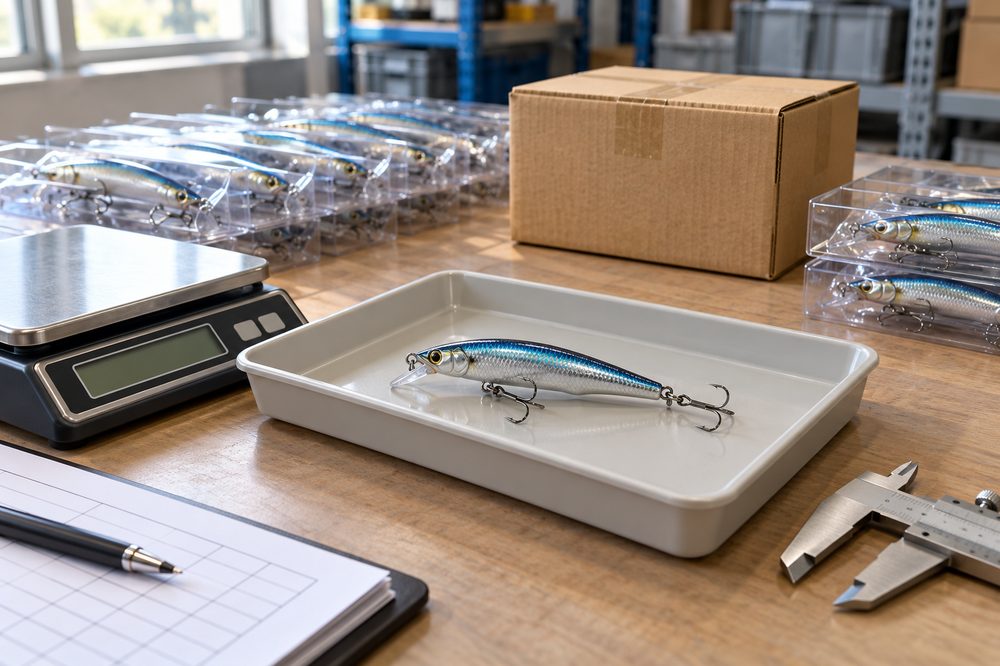
An approved sample answers one question: can this version of the lure meet your brief? It does not tell you whether the production order has the correct hooks, whether all colors were packed correctly or whether a different batch of soft material behaves the same way. Those questions belong to the shipment inspection.
For a tackle buyer, an inspection is most useful when the decisions are made before the inspector arrives. Define the lot, agree what counts as a defect and decide which tests require equipment or advance preparation. The approach below is a buyer’s planning framework for lures and their retail packaging, not a universal test standard for every fishing product.
Give the inspector a usable reference
Send the purchase order, current specification, approved artwork and sample reference in one controlled package. Include the variant list and carton configuration. If the production specification changed after sample approval, identify the accepted revision and explain which physical sample remains valid. Otherwise the inspector may be comparing two legitimate but different versions.
QIMA describes pre-shipment inspection as a sample-based process that can cover specifications, workmanship and packaging, with checks tailored to the product and buyer. [1] Tell the inspection provider which goods are available and how they are distributed across cartons. Ask it to confirm the readiness conditions required for a meaningful visit.
Make sampling assumptions visible
An AQL plan uses a defined lot size, inspection level and acceptance criteria to determine the sample and rejection threshold. QIMA explains this process using ISO 2859 and ANSI/ASQ Z1.4 sampling references. [2] Agree the applicable plan with the inspection provider rather than selecting a percentage of cartons informally.
AQL is not a promise that the entire shipment contains no defects, and an AQL value is not a permitted defect percentage for every box. Sampling supports a decision about the lot with uncertainty. Critical risks may require controls beyond an ordinary sampling plan; a zero-acceptance criterion in a sample does not prove zero defects throughout production.
Explain how different sizes and colors will be represented. A pooled sample can leave a small variant barely examined. Ask whether separate lots or additional targeted checks are appropriate, and document the decision. Keep any extra functional test sample distinct from the main visual inspection sample so that the report is interpretable.
The findings above are examples to discuss before inspection. Their severity and acceptance criteria depend on the product specification, intended use and agreed risk assessment.
Choose functional checks that answer a real question
For hard baits, consider tracking, buoyancy, water ingress and attachment security. Define the method for each agreed check. Record the water conditions, tackle connection, duration and acceptance criterion for a swim test. If a pull test is needed, specify the fixture, loading direction and equipment; an improvised hand pull provides little comparable evidence.
For soft baits, compare dimensions, body consistency, obvious molding defects and the intended rig fit. Check tail shape after removal from the retail pack. If recovery, stretch or tear resistance matters, ask a qualified provider to set a repeatable method and acceptance limit. A dramatic stretching video alone does not establish a dependable purchasing specification.
Separate short on-site checks from laboratory work. A corrosion claim, for example, needs a relevant agreed protocol and sufficient test time. Do not expect a final inspection visit to create missing durability evidence. Book that work earlier and make sure the report identifies the components and product revision actually ordered.
Inspect the retail pack as carefully as the lure
Open selected packs and count the contents. Match the physical size and color to the label, then scan the barcode and compare its decoded value with the approved data. Inspect hook protection where specified, packaging damage and whether movement inside the pack can harm the finish. For soft baits, check for leakage and persistent deformation.
Verify the carton arrangement against the packing list. A change in case quantity can also affect product identification: GS1 requires a new GTIN for the affected case configuration when the number of trade items in the case changes. [3] Check the packaging hierarchy with the person managing your identifiers before accepting a last-minute packing change.
Ask for a report that supports a release decision
The report should connect each finding to the checked item and the agreed requirement. Ask for the lot and sample sizes, defect counts by category, measurements and clear photographs. Functional results should identify how many units were tested. A photograph of one good lure is not evidence that a whole functional sample passed.
Where a requirement cannot be verified, record it as unresolved. Do not allow a missing test to become an assumed pass. The buyer needs to know whether the gap is a missing document, unavailable equipment or a product failure because each requires a different response.
Agree what happens when the order fails
Before inspection, define who authorizes release and what happens after a rejection. Ask the supplier to identify the cause, separate affected goods and describe the correction. Decide with the inspection provider whether reinspection should cover the whole corrected lot, an identified subset or additional characteristics exposed by the failure.
Keep the original report and the corrective-action record. If you accept a deviation, state exactly which items and quantity it covers; do not silently change the specification for future orders. A useful release decision names the goods, the revision and the evidence supporting shipment. That record becomes particularly valuable when the next order arrives.