
Hard lure is a category, not a specification
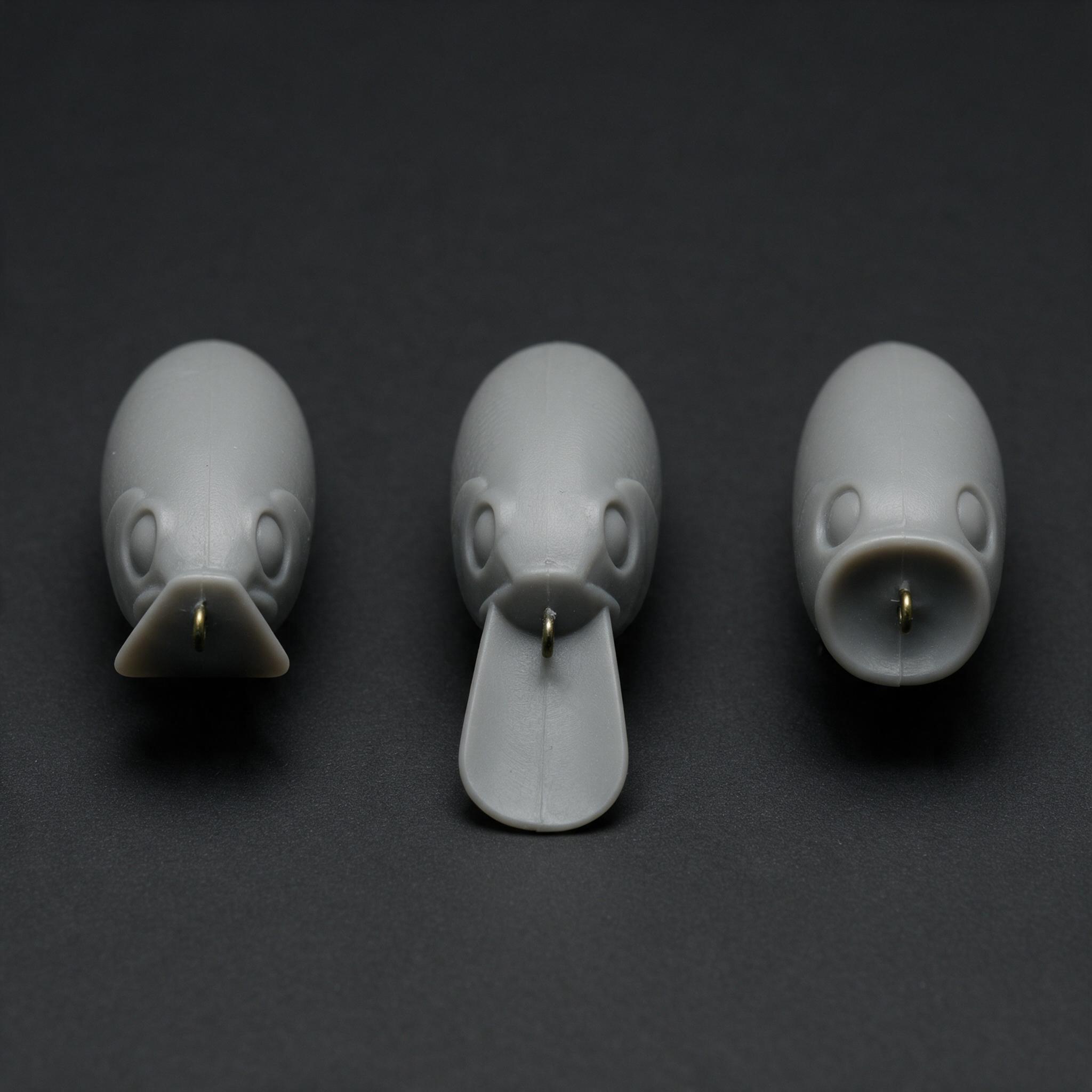
Minnow, crankbait and popper are three separate toolings with three separate behaviours, so they cannot be quoted as one line.
- Minnow, crankbait and popper are three toolings, three behaviours and three quotations, not one product line.
- Diving depth and running attitude are set by bill geometry, which is fixed in the mould and cannot be changed after tooling.
- Our six-listing sample sits at US$1.85 to US$3.20 per piece with MOQ 100 on every listing, the most uniform MOQ band in the catalogue.
A hard lure is the type where the most important field is the one that cannot be changed after the money is spent.
Three toolings, not one product
Minnow, crankbait and popper are filed together in most catalogues, including ours, and they are not one product. They are three moulds, three bill geometries and three assembly sequences. Each behaves differently in the water and each carries its own quotation.
That is the trap in a request for a hard lure price. A supplier asked to quote hard lures will quote whichever sub-type it actually holds, and the buyer receives a number that is correct for a product they did not specify.
The bill commits you
Diving depth and running attitude are set by the geometry of the bill. The bill is formed in the mould. Once the tool is cut, the depth is committed, and no amount of sample tuning changes it.
This is the structural difference between a hard lure and a soft one. A soft plastic mould can be run in several material packages and colours, and the same tool produces a range. A hard lure tool produces one behaviour. Buying a hard lure is therefore a tooling decision before it is a product decision.
It is also why the US habit of shopping crankbaits by running depth translates directly into a mould specification rather than a fishing preference.
What the sample shows, and what it does not
Our hard-lure sample holds six listings at US$1.85 to US$3.20 per piece, with MOQ 100 on every one. That is the most uniform MOQ band in the catalogue.
It would be easy to read that as a stable category. It is not. The six listings happen to share a sub-type, which is why they quote close together and why the MOQ is flat. The band is a price for those six products, not a price for hard lures.
The sample spans a floating minnow, a deep-diving long-bill, a 140mm pencil, a sinking popper and a trolling metal jig. Two of the six are sold by the bag, so the unit has to be checked before any comparison is made - the same failure we record across the catalogue.
The hook hanger is a structural field
Hard bait bodies are ABS or composite, and the hook attaches either through a wire that runs through the body or onto a moulded hanger formed with the body. Those are different structures with different failure behaviour and different tooling.
It is a field buyers skip because it is invisible, and it is the field that decides whether a hook pulls out of the body under load. It belongs in the order.
What the order has to state
- Sub-type. Named, because it determines the tooling.
- Bill geometry or target running depth. Fixed at tooling, so it must be agreed before the mould is cut.
- Body material and hook hanger type. Through-wire or moulded, stated rather than assumed.
- Hook configuration. Treble count and sizes, quoted separately.
- Finish. Colour, foil and eyes, the last step and the cheapest to change.
Sources 3 cited
- The six-listing hard lure sample behind every figure on this page
- The companion guide on buoyancy class, which is the field soft-bodied and hard-bodied lures do not share
- Our rule for separating a claim from its evidence
Every figure on this page traces to one of these. The same list is declared in the page structured data (schema.org citation) and in the Markdown twin.