
Floating, suspending or sinking minnows
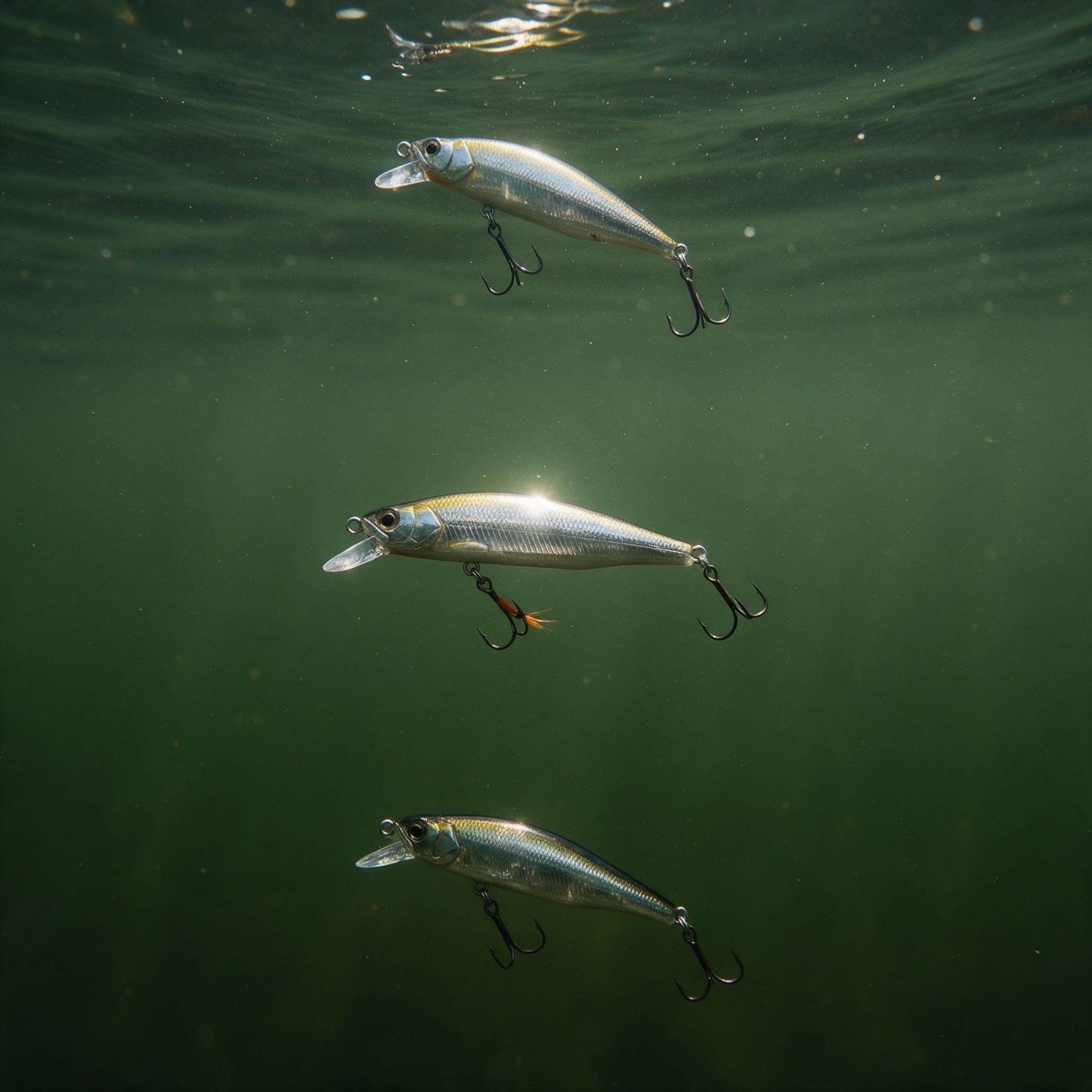
A minnow body can be built in three buoyancy classes - floating, suspending and sinking - and the class decides which depth band the lure fishes, not the shape.
- Floating, suspending and sinking are three constructions of the same body; the difference is ballast, not shape.
- Buoyancy decides the depth band and the retrieve the lure suits, so it is the first field the order should carry.
- Suspending is the class most often confused with floating, because both sit still at rest on the surface until the ballast is set.
Three products come out of one mould, and the field that separates them is the one a listing is least likely to state.
The same body, three constructions
A minnow is a hard body shaped to read as a baitfish. What it does in the water is decided after moulding, when the ballast goes in. Set the ballast one way and the lure rises when you stop retrieving. Set it another way and it holds its depth. Set it a third way and it keeps sinking.
Those are floating, suspending and sinking, and they are three products. The shape, the finish and the hook configuration can be identical across all three.
Why the class is the first field
Buoyancy decides which depth band the lure works and which retrieve suits it. A floating minnow is a shallow-cover tool. A suspending minnow covers the middle band and rewards a pause. A sinking minnow reaches deep water and casts long.
So a buyer who specifies a shape and a length has specified the appearance of the product and left its function open. The factory will fill that gap with its standard ballast, and it will do so consistently and correctly from its own point of view.
The confusion worth naming
Floating and suspending are confused constantly, and the reason is structural: both rest at the surface before the retrieve begins. The difference only appears after the pause. A floating minnow rises; a suspending minnow holds.
That difference is invisible in a photograph, invisible in a video that does not show a pause, and decisive in the water. It is also the reason a buyer who has only ever seen listings can believe they have compared two products when they have compared one product twice.
The claim to treat carefully
Packaging frequently states a diving depth. That is a claim about one retrieve speed on one line class. Change the retrieve speed or the line diameter and the number changes, which makes it a starting point to verify rather than a specification to order against.
State the depth band you actually need. It is a more useful field than a number the factory cannot reproduce without knowing your retrieve.
What a minnow order has to state
- Buoyancy class. Floating, suspending or sinking, stated explicitly.
- Length and weight. Together they set the sink rate of a sinking model, which length alone does not.
- Line-tie position. It decides how the lure tracks under a steady retrieve.
- Hook configuration. Treble count and size, quoted separately.
- Finish. Colour and foil, the last step and the cheapest to change.
Sources 3 cited
- The sampled minnow and hard-lure records behind this page
- How the hard lure range is filed by type
- Our rule for separating evidence from a claim
Every figure on this page traces to one of these. The same list is declared in the page structured data (schema.org citation) and in the Markdown twin.