
A custom soft plastic is four decisions
A custom soft plastic is four separate decisions rather than one - the mould, the material package, the colour standard and the pack format - and a factory can only quote once all four are settled.
- A custom soft plastic is four decisions: mould, material package, colour standard and pack format.
- Our six-listing sample spans US$0.20 to US$3.85 per piece, and MOQ runs 50 to 1,000 pieces.
- The cheapest listing is a luminous sabiki shrimp bait at US$0.20-0.23 per piece at MOQ 1,000; the dearest is a 3D-printed PVC flying-fish bait at US$3.75-3.85 at MOQ 100.
Soft plastics are the type where the mould is the cheapest decision and the other three are where the order actually goes wrong.
Four decisions, settled separately
A custom soft plastic involves the mould, the material package, the colour standard and the pack format. Each is quoted on its own, each moves the MOQ on its own, and none of them implies the others.
Buyers tend to treat the mould as the whole decision because it is the biggest single line. In practice the material package decides how the bait behaves and how long it lasts, the colour standard decides whether two production runs match, and the pack format decides whether the price you are quoted is comparable to the price you were quoted last time.
What the MOQ spread means
Our soft-lure sample holds six listings spanning US$0.20 to US$3.85 per piece, with MOQ running from 50 pieces to 1,000. That is a 20x spread inside a single sub-category, and it is worth reading carefully because it is not a negotiation range.
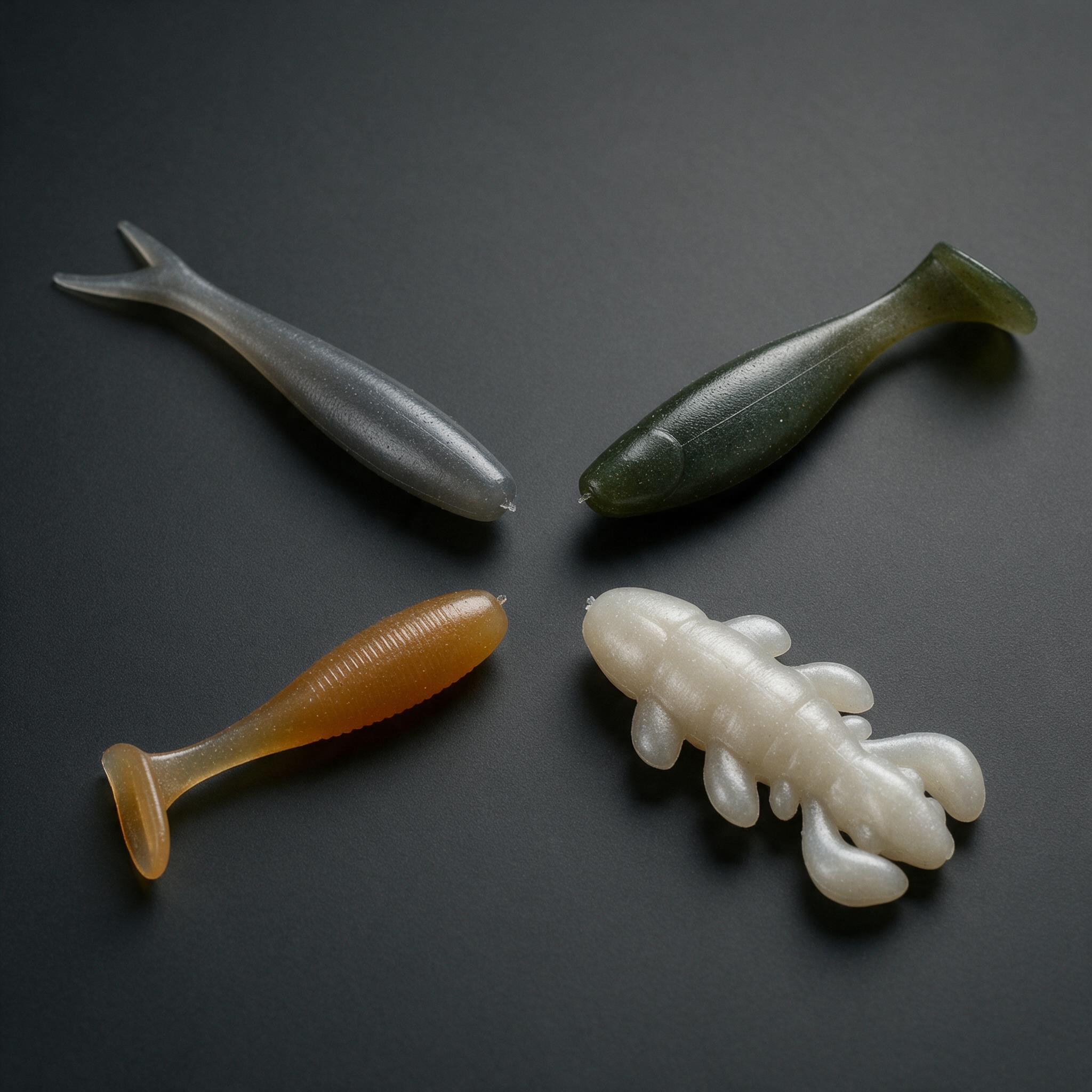
The 1,000-piece floor belongs to a luminous sabiki shrimp bait at US$0.20 to US$0.23 per piece. The 100-piece floor belongs to a 3D-printed PVC flying-fish bait at US$3.75 to US$3.85. The cheap end is a high-volume moulding; the expensive end is a different process with a different tooling and a different unit cost. Treating the two as the same product at different price points is the mistake the spread invites.
Colour is cheap, a logo is not
Colour is a changeover cost rather than a tooling cost, which means adding a colourway to a mould you already own is comparatively inexpensive. That is the structural advantage soft plastics have over hard lures, where the behaviour is committed when the tool is cut.
A logo is a different matter. Applying artwork is a second process step, and only some bait forms can carry it without one. A buyer planning a logo on a bait should establish that before the mould, not after.
Lead time is two answers, not one
A stock mould and a new mould carry different lead times. Our record states which case applies rather than publishing a single figure, because a single figure would be wrong for one of the two and a buyer planning a launch around it would be worse off than one who was simply told to ask.
What the order has to state
- Mould source. Stock or new tooling, and who owns the tool.
- Material package. The plastic and any additive, stated, because it decides both action and durability.
- Colour standard. With a reference the factory can match against, not a name.
- Pack format and count. The denominator that makes two quotations comparable.
- Dimensions. Length and profile, plus whether the bait carries a printed or 3D-formed element.
Sources 3 cited
- The six-listing soft lure sample behind every figure on this page
- How the four decisions map onto a first order
- Our rule for separating a claim from its evidence
Every figure on this page traces to one of these. The same list is declared in the page structured data (schema.org citation) and in the Markdown twin.